BASSETERRE, St. Kitts — WHILE white-collar crime remains a concern in the Federation, incidents continue to be relatively low, though persistent, as cybercrime and larceny increasingly impact residents.
An investigation by SKNVibes News, in collaboration with the Media Institute of the Caribbean (MIC), back in 2023 found that white-collar crime and online scams affect the public, highlighting the need for greater education to help residents avoid falling victim.
When questioned by this media house during the Police Force’s first press conference for 2026, Commissioner of Police James Sutton revealed that three white-collar crime cases were recorded in 2024, compared to four in 2025.
Both the Government and the Royal St. Christopher and Nevis Police Force have been working to remain aligned with regional and international legislative requirements, including those related to anti-money laundering and countering the financing of terrorism.
At the end of last year, the Federation’s White-Collar Crimes Unit received regional recognition for its work—an achievement acknowledged by the Commissioner.
“As you know, our White-Collar Crime Unit was awarded regionally for the conduct of a white-collar crime [investigation] from start to finish, and it is now being used as a model investigative case across the region,” Sutton told reporters.
What Is White-Collar Crime?
In responding to SKNVibes News, Commissioner Sutton explained that white-collar crime refers to non-violent, financially motivated offences, "that we crimes of greed, pertaining to financial transactions, where persons tend to engage in non-violent crime, but very more economically inclined crimes, such as money laundering,” he said.
He further explained that such crimes often stem from a predicate offence.
“For example, a fraud - you commit a fraud where you receive some advantage or some financial benefit, and you use this benefit to your advantagr through concealment and other means," Sutton noted.
Police have recently arrested several foreign individuals who entered the Federation with the intention of skimming credit and debit cards.
“Recently, we would have arrested a number of non-nationals—at least four—who would have come to St. Kitts and begun using devices to get money from our financial institutions. Because of counterparts, we were able to apprehend these pesons, [and] awaiting trial,” Sutton added.
He asserted that incidents such as these have spillover effects, including money laundering.
Residents Targeted by Online Scams
Residents in St. Kitts and Nevis have increasingly become targets for online scams, cybercrime, fraud, and hacking. Data indicate that a number of these incidents continue to occur, with scammers exploiting trust and limited digital awareness.
Recently, financial institutions including CIBC Caribbean have issued advisories warning customers that they do not run unsolicited promotions and would never request sensitive personal information.
Like many Caribbean islands, including Jamaica, St. Kitts and Nevis has also seen a rise in social media scams, many of which emerged during the COVID-19 pandemic.
Last year, several residents reported that their WhatsApp accounts had been hacked, with scammers using the compromised accounts to solicit funds from unsuspecting contacts. The Police Force subsequently warned the public to remain vigilant, noting that one of its own had been affected.
The Samsung Scam
These developments come against the backdrop of the widely circulated Samsung scam during the height of the pandemic. SKNVibes’ investigation with MIC revealed that numerous individuals across St. Kitts and Nevis and the wider Caribbean received messages claiming they had won large sums of money.
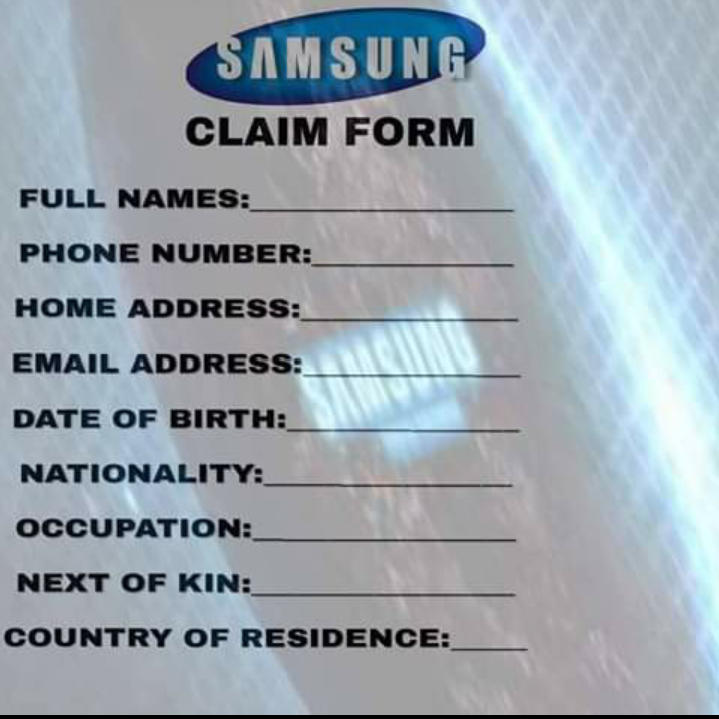
The fraudlent registration form (compliments of the Media Institute of the Caribbean)
In one instance, recipients received WhatsApp messages stating they had won US$800,000, allegedly sent from numbers including 234-810-804-9966, 234-810-281-8725, 234-904-898-1499, and 234-909-678-4532.
Scammers further claimed that winners had also received a motor vehicle and a Samsung Galaxy S21, instructing them to complete forms and pay fees to facilitate delivery of the winnings through direct deposit, home delivery, or money service providers.
One message stated: “This is real and 100% legitimate… done to eradicate poverty in St. Kitts and Nevis by the United Nations, Samsung Company and the USA Trust Fund Organization.”
The scam prompted Samsung to issue a media statement confirming that it had received several reports of fraudulent communications using the company’s name and logo, and appear to be authorised communications from Samsung.
“In light of these incidents, Samsung would like to encourage customers to exercise particular vigilance when interacting with third parties over email, internet, phone or text message,” the statement said.
Businesses also affected
White-collar crime has not been limited to individuals. Businesses across the Federation have also been compromised. During a 2023 investigation, Inspector Jerry Watts confirmed that several businesses were impacted by phishing schemes, where unsuspecting employees clicked malicious email links, compromising entire systems.
“We have seen instances where monies were redirected by the payee to individuals who were not intended to receive the funds,” Watts explained.
Assessing the full extent of white-collar crime remains challenging, as many of these offences are recorded under larceny in the Police Force’s crime statistics.
The full crime statistics report for 2024 is expected to be released in the coming days. The full MIC report can be read here