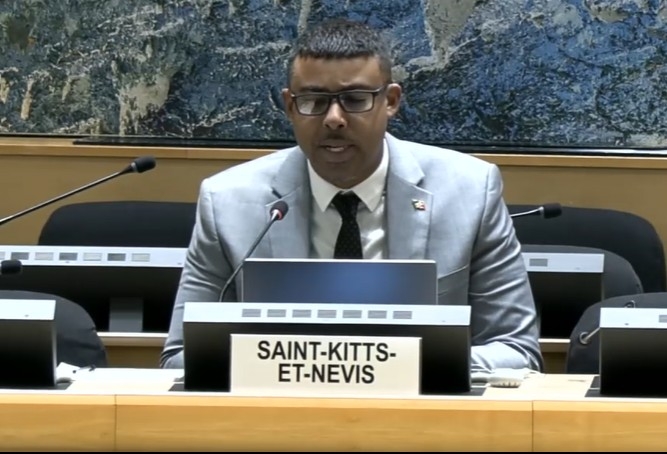
WASHINGTON, DC — ATTORNEY-General Garth Wilkin on Tuesday (Jan. 27) presented the Federation’s Human Rights Country Report before the United Nations Geneva Office, underscoring that implementation of recommendations matters just as much as commitment, with emphasis placed on institutional coordination, accountability, and follow-up.
In his 15-minute presentation, Wilkin outlined ongoing efforts by the Government to address challenges while building on the progress made over the years to improve the well-being of citizens.
He told the UN body that St. Kitts and Nevis’ approach to human rights is grounded in “constitutional governance, the rule of law, and a people-centred development philosophy.” He noted that this approach is rooted in a 43-year-old Constitution and reflects local priorities founded on “strong modern constitutional fundamental rights,” while also being shaped by “the realities of limited institutional capacity, vulnerability to external shocks, and the responsibility to ensure that reforms are sequenced, sustainable, and capable of real implementation.”
Addressing recommendations arising from the Universal Periodic Review (UPR), Wilkin said the Government is strengthening a national mechanism for implementation, reporting, and follow-up to consolidate recommendations from the UPR, treaty bodies, special procedures, and relevant regional mechanisms.
He highlighted several key human rights areas currently being prioritised, including judicial independence, which he described as a cornerstone of the constitutional order and public confidence in the rule of law.
“Judicial appointments in Saint Kitts and Nevis operate within a regional constitutional framework through the Eastern Caribbean Supreme Court, which provides an additional layer of institutional independence beyond national processes. Within this framework, the Judicial and Legal Services Commission exercises its functions in accordance with constitutional safeguards designed to insulate appointments from undue influence and reinforce merit-based decision-making,” Wilkin said.
He added that the Government continues to strengthen legal aid and access-to-justice mechanisms through phased and sustainable reforms, recognising that meaningful access requires expanded coverage, quality service, institutional readiness, and fiscal sustainability.
Gender equality, Wilkin noted, remains a national priority, with the administration continuing the phased implementation of the Gender Equality Policy and Action Plan 2022–2027 through stronger inter-ministerial coordination, including active gender focal points across government.
“Gender considerations are increasingly integrated into social protection, education, citizen security, and climate resilience frameworks. In parallel, the government has advanced the development of a National Social Protection Policy and Action Plan for 2025–2030,” he said.
The Attorney-General also addressed domestic and sexual violence, noting that the Government is working to tackle exploitation and other forms of harm through strengthened legal safeguards, institutional protocols, training, and sustained public education.
The Government, he said, remains open to technical cooperation to improve coordination, data collection, and service delivery in this area. He pointed to significant progress in violence reduction, noting that homicides declined by 75 per cent from 2024 to 2025 — a 68 per cent decrease from the 15-year average — representing one of the most significant reductions across the Caribbean, a region long affected by youth and gang-related violence.
“We don’t just talk the talk, we walk the walk when it comes to human rights-related reform,” Wilkin stated.
Work is also underway to strengthen standard operating procedures across correctional, health, and justice institutions to improve sanitation, healthcare access, risk management, and consistency of practice.
Wilkin acknowledged ongoing international discussions on criminal defamation and its potential chilling effect on freedom of expression, noting that the Government’s approach is to examine the issue within the broader context of legal modernisation, proportionality, access to remedies, and comparative practice. At the same time, he said the Government supports efforts to promote responsible journalism, media ethics, and public trust through training and engagement.
The Attorney-General acknowledged that challenges remain, particularly in human and technical capacity, data availability, and competing reporting obligations. “Our experience highlights the importance of pragmatism, institutional ownership, and targeted technical cooperation to ensure sustainability. Institutional strength is particularly critical in the administration of justice,” he said.