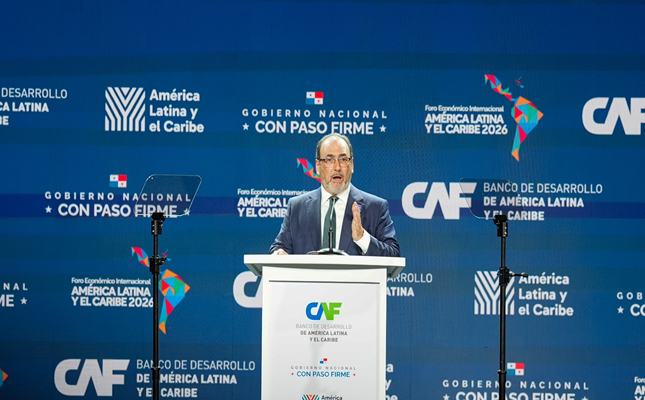
At CAF’s International Economic Forum in Panama, seven heads of state from the region were brought together and discussed strategies to position Latin America and the Caribbean as a region of solutions to the major challenges of global development.
(Panama City, January 29, 2026) -- In a global context marked by geopolitical fragmentation, bilateralism, and uncertainty in international trade, Latin America and the Caribbean raised its voice on the first day of the International Economic Forum, organized by CAF - Development Bank of Latin America and the Caribbean.
With the participation of the heads of state of Brazil, Colombia, Panama, Ecuador, Bolivia, Guatemala, and Jamaica, the president-elect of Chile, and more than 4,300 experts and global political and business leaders, the forum reached a consensus that the region must, and can, move beyond its reputation as a “continent of missed opportunities” and emerge instead as a source of solutions.
This is an unprecedented gathering, both in terms of the number of Heads of State and global leaders in attendance and the broad representation of ideological perspectives, reaffirming the importance of multilateralism in Latin America and the Caribbean. The International Economic Forum 2026 aims to be a space for asking difficult questions, examining both successes and failures, and engaging with thoughtful, in-depth perspectives.
CAF’s Executive President, Sergio Díaz-Granados, said that “the global landscape presents us with an unprecedented scenario: we are experiencing a rupture in the rules-based system. An imperfect system, but one that provided a foundation of certainty, is now being challenged by another, centred on competing interests and disputes over the control of elements essential for the digital and energy transitions.”
The call for unity and integration also came from other leaders. Luiz Inácio Lula da Silva, President of Brazil, defended multilateralism and cooperation as essential pillars. "Remaining divided makes us all more vulnerable," he stated before the assembly. "In a context of the breakdown of the liberal order, the resurgence of protectionism and unilateralism, Latin America and the Caribbean need to act pragmatically and accept that the only viable integration is one based on plurality, cooperation, and concrete results."
For his part, Gustavo Petro, President of Colombia, emphasized during his speech the importance of promoting dialogue between civilizations as the basis for building peace, as well as the value of human fraternity as an essential condition for freedom and the defence of life. “If we want peace and fraternity, there must be dialogue between civilizations. Only through human fraternity is freedom possible, and without comprehensive freedom and without the defence of life, we do not fully exist as human beings.”
Panamanian President José Raúl Mulino emphasized the importance of prioritizing dialogue and regional cooperation. “Our people are asking us to focus more on what unites us than on what divides us. Panama is not a competitor to other countries, but rather a complement to their economies, and the Panama Canal is at the service of Latin America and the Caribbean,” he stated. The president also expressed his gratitude to CAF, and the leaders present for their joint efforts in promoting a shared regional agenda.
Rodrigo Paz, President of Bolivia, said that Latin America must once again begin to build its future with truth; a truth based on a culture of verifiable trust among countries, governments, and societies. Paz also questioned ideological approaches that hinder productive development and noted that employment, education, and economic integration should be at the centre of the regional agenda.
The discussion also directly addressed the internal challenges that limit regional potential. Ecuadorian President Daniel Noboa focused his message on the intrinsic relationship between economic stability, citizen security, and social well-being. He made an explicit call to protect nations against the scourge of drug trafficking and to expand the metrics of progress beyond Gross Domestic Product.
This view was reinforced by Chile's president-elect, José Antonio Kast, who warned that "without security, democracy is a fiction." Kast emphasized that the rise of transnational organized crime represents an existential threat to democratic institutions and that confronting it requires "tough, effective, and uncompromising" regional cooperation.
"For too long, our region has been described primarily through the language of vulnerability," said Jamaican Prime Minister Andrew Holness. "But vulnerability is not destiny. We are not peripheral to the global system; we are central to its stability, sustainability, and future growth."
Guatemalan President Bernardo Arévalo agreed on the urgency of a clear and coordinated approach. “We need more unity, more integration, coordination, and interconnectedness, as well as a renewed commitment to an international system based on law and peace, and robust and sustainable financing for development,” he declared. His remarks emphasized the need to translate these principles into financial and governance mechanisms that will make cooperation a reality.
The leaders converged on the idea that global dilemmas, from the energy transition to inequality, and regional challenges such as inequality, insecurity, and the need for industrialization require collective responses.
The first day of the Forum in Panama laid the groundwork for a collective action agenda. The region is not only demanding its own global space, but is also demonstrating, through dialogue and the identification of priorities, that it can build it. Over two days, the CAF Forum in Panama will discuss how to generate political consensus on concrete projects for physical, digital, trade, and security integration, with the aim of positioning Latin America and the Caribbean as an indispensable bloc for the future of global development.
The agenda includes key topics such as economic growth, regional integration, sustainability, investment, inclusion, and competitiveness, with the aim of building, through dialogue, concrete solutions that will drive the development of the region.
The complete agenda for the 2026 Latin America and Caribbean International Economic Forum is available at: https://www.caf.com/en/specials/international-economic-forum-latin-america-and-the-caribbean-2026/
The event can be viewed live on CAF's YouTube channel: (62) CAF -banco de desarrollo de Latam y el Caribe- - YouTube
You can access the images and videos at this link: https://www.caf.com/es/especiales/foro-economico-internacional-america-latina-y-el-caribe-2026/media-center/
Disclaimer
This article was posted in its entirety as received by SKNVibes.com. This media house does not correct any spelling or grammatical error within press releases and commentaries. The views expressed therein are not necessarily those of SKNVibes.com, its sponsors or advertisers

 Trinidad & Tobago News