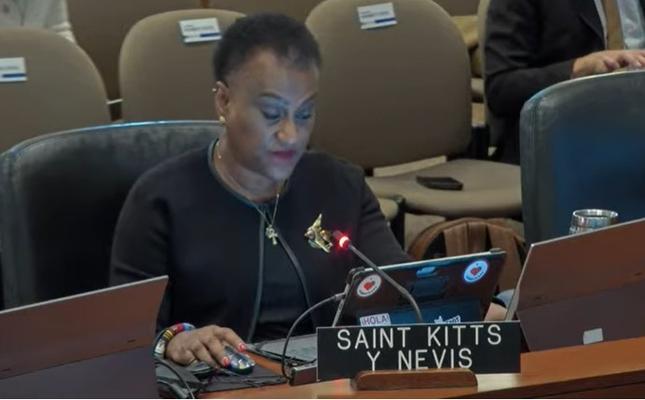
WASHINGTON, DC — ST. Kitts and Nevis joined fellow member states of the Organization of American States (OAS) in observing International Holocaust Remembrance Day, pausing to reflect on one of history’s greatest human tragedies.
Speaking during today's 9Feb. 4) sitting of the OAS Permanent Council, Ambassador Jacinth Henry-Martin described the persecution and murder of millions of Jews as among the world’s “darkest chapters.”
“The Holocaust stands as a stark reminder of where unchecked hatred, xenophobia, racism, and state-sponsored discrimination can lead. It was not only an assault on a people, it was an assault on human dignity itself, a reminder not merely to never forget, but to always remain vigilant. The normative international frameworks established in law and principle in the aftermath of such atrocities, to ensure that such horrors would never be repeated, have been strengthened within our own hemisphere.”
She pointed to regional human rights frameworks — including the American Declaration of the Rights and Duties of Man, the American Convention on Human Rights, and the Inter-American Democratic Charter — as pillars that reaffirm equality, human dignity, and non-discrimination as democratic foundations.
The ambassador also highlighted the organization’s adoption of targeted instruments to confront racism and intolerance, including the Inter-American Convention Against Racism, Racial Discrimination, and Related Forms of Intolerance, and the Inter-American Convention Against All Forms of Discrimination and Intolerance. She noted that these measures acknowledge how unchecked prejudice and exclusion can weaken social cohesion and create conditions for atrocity crimes.
“History teaches us that genocide and ethnic cleansing do not begin with mass violence. As in the case of the Holocaust, they begin with words, with stereotypes, with policies that divide, and with silence in the face of discrimination. For small diverse societies such as St. Kitts and Nevis, these lessons are deeply resonant.”
Henry-Martin stressed that the strength lies in coexistence and mutual respect, and in the recognition that every person — regardless of origin, race, religion, or identity — deserves equal protection and opportunity.
She urged continued vigilance against intolerance, emphasizing that safeguarding human rights is a shared responsibility that extends beyond governments.
“Let us speak when intolerance surfaces, act when rights are threatened, and stand together when any people face persecution simply for who they are. At the same time, we must also recognise with sobriety and purpose that this vigilance is not the responsibility of governments alone. Each of us has a role to play in our personal and professional lives alike.”
In closing, the ambassador called for renewed commitment to democratic values and the rule of law.