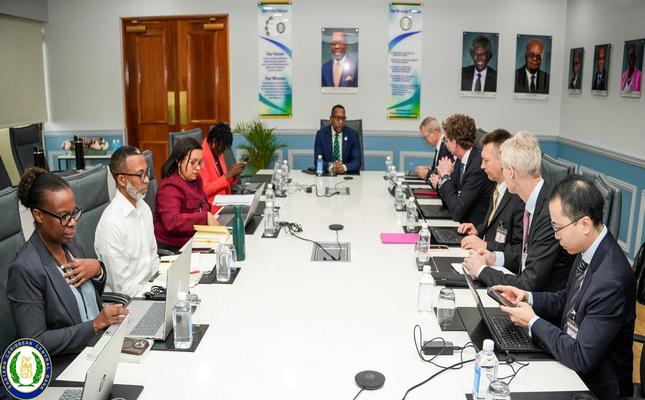
BASSETERRE, St. Kitts — THE International Monetary Fund (IMF) has completed its latest consultations with the Eastern Caribbean Central Bank (ECCB) on the performance of the Eastern Caribbean Currency Union (ECCU), highlighting both strengths and ongoing vulnerabilities across the subregion’s economy.
In its concluding statement following the visit, the IMF team said the Currency Union “continues to provide a strong anchor for macroeconomic stability in a shock-prone region.”
Officials pointed to solid post-pandemic growth driven largely by tourism and construction, while noting that inflation has moderated in line with global trends.
“Over the medium term, ECCU economies are expected to converge toward modest pre-pandemic average growth, with downside risks dominating amid elevated global uncertainty,” the statement said. “To manage these risks while supporting resilient long-term growth and safeguarding the quasi-currency board, policies should prioritize stronger fiscal sustainability and accountability aligned with the regional debt target, alongside measures to strengthen financial system resilience and intermediation.”
The IMF noted that strong tourism arrivals and continued infrastructure investment supported regional growth of about three percent last year. Inflation — a key concern across the subregion and the wider CARICOM area — has eased alongside global fuel and food prices, with limited direct impact so far from shifts in U.S. trade policies.
However, fiscal outcomes have not kept pace with economic performance. Public debt reduction across the Currency Union has stalled, partly due to recurring external shocks, and several member states are now at increased risk of missing the regional target of reducing debt to 60 percent of GDP by 2035.
While the financial system remains broadly stable, the IMF flagged lingering weaknesses in bank balance sheets and vulnerabilities within the nonbank sector, where regulatory oversight remains fragmented.
Looking ahead, the Fund expects economic momentum to slow. With tourism operating near full capacity, average regional growth is projected to moderate to around 2.5 percent over the medium term, constrained by productivity challenges, demographic pressures, and limited fiscal space for public investment.
The IMF stressed that uneven progress in debt reduction underscores the need for stronger union-wide institutional mechanisms to reinforce fiscal sustainability. Meeting the 60 percent debt target by 2035 is becoming increasingly uncertain without coordinated policy action.
The ECCB was urged to maintain strict compliance with prudential standards and strengthen incentives for banks to write off unrecoverable non-performing loans (NPLs). Although banks meet regulatory provisioning and capital requirements, the system-wide NPL ratio remains above the ECCB’s benchmark of five percent, with many impaired loans overdue for years.
The transition to the Basel II/III framework is continuing and could require additional capital buffers. The IMF recommended a targeted internal review of bank assets — including real estate exposure, foreign investments, sovereign holdings, and risk concentration — to support stronger safeguards. It also encouraged continued strengthening of the regional financial safety net and resolution framework to complement the new deposit insurance scheme.
The Fund called for the prompt establishment of the Eastern Caribbean Financial Standards Board to improve regulation of the nonbank sector. Harmonized standards, it said, would create a more level playing field and reduce opportunities for regulatory arbitrage.
According to the IMF, the region’s long-term growth potential has weakened over the decades due to declining productivity and structural barriers to investment. These include limited access to credit, administrative bottlenecks, and gaps in workforce skills.
A coordinated regional strategy is needed to ease these constraints and strengthen resilience, the Fund said.
Deeper trade integration was identified as a key opportunity for growth and diversification. At present, connectivity challenges limit expansion into new markets. The ECCU remains heavily reliant on the United States and trades less than expected with partners outside the Caribbean, largely due to shipping and airlift limitations.
The IMF recommended stronger regional policy coordination to address these barriers, including harmonized customs procedures, a unified single-window trade platform, and mutual recognition agreements to improve institutional efficiency and reduce costs.