BASSETERRE, St. Kitts -- AS the EU-Caribbean Parliamentary Assembly continues, a warning has been sounded that gender inequality continues to undermine Caribbean economic growth, arguing that trade, finance and macroeconomic policy cannot be separated from the structural barriers facing women.
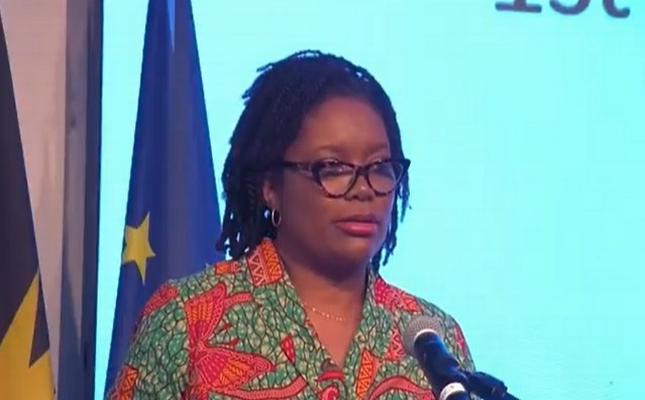
Speaking at a regional forum in Antigua and Barbuda, Isiuwa Iyahen, Deputy Representative and Head of Office at Interim for the United Nations Women Multicountry Office, Caribbean, said gender gaps are not a social side issue but a core development challenge affecting productivity, competitiveness and long-term sustainability across Small Island Developing States (SIDS).
The forum builds on discussions from the Fourth International Conference on SIDS hosted in Antigua and Barbuda last year, which produced a comprehensive framework aimed at advancing sustainable development and social equity. However, participants acknowledged that the Caribbean continues to face deep structural economic challenges, including slow regional integration and persistent inequalities that limit women’s participation in trade and investment.
The official stressed that gender equality must be treated as an economic priority, not a peripheral concern.
“ So, gender equality is not peripheral to trade, it’s not peripheral to investment and economy,” the speaker said, warning that unless cultural, social and economic barriers are dismantled, gender gaps will continue to widen and weaken the region’s ability to benefit from trade agreements.
Women already play a central role in Caribbean economies. According to Iyahen, in many countries, they own 40 percent or more of micro, small and medium-sized enterprises (MSMEs) and are heavily represented in tourism, hospitality, retail, agro-processing, creative industries and services — sectors considered vital to regional competitiveness.
Yet despite their presence, women entrepreneurs remain significantly underfinanced. According to figures cited at the forum, women-owned firms receive roughly ten times less financing than businesses owned by men. Average medium- and long-term loans to women-led enterprises stand at about US$156,000, compared with US$1.5 million for male-owned businesses. Limited access to collateral remains a major barrier, restricting women’s ability to formalise operations, expand and enter export markets.
Iyahen described this as an active marginalisation of women’s economic potential and called for targeted investment tools and stronger enabling environments. Issues often dismissed as social concerns — including unpaid care burdens, financial exclusion and personal safety — were identified as direct economic constraints that spill into trade participation.
Global data from the International Finance Corporation estimates that women-led MSMEs face a US$1.7 trillion financing gap worldwide. In the Caribbean, access to trade finance and export guarantees remains particularly limited for women entrepreneurs.
The forum heard calls for gender-responsive macroeconomic policies that deliberately measure and close financing gaps, alongside greater support for women’s leadership in shaping economic strategy. The European Union was commended for ongoing regional partnerships promoting decent work, equal pay and entrepreneurship.
Higher interest rates and tighter lending conditions disproportionately hurt women, delegates were told, because women are overrepresented in small or new businesses that banks often view as risky. When liquidity shrinks and microfinance providers scale back, women entrepreneurs are typically the first to feel the impact.
MSMEs account for more than half of GDP and employment across Caribbean economies, forming the backbone of the private sector. Yet only about one-fifth of firms have formal gender equality measures in place, a gap that experts say limits innovation and wastes talent.