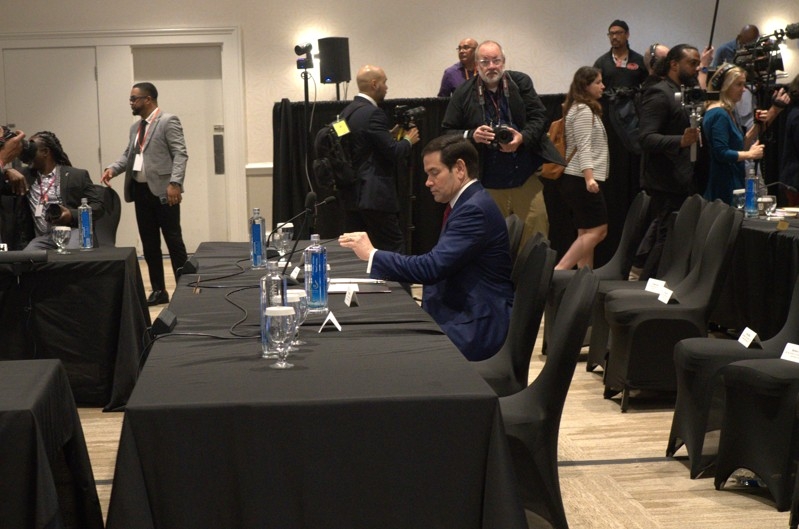
BASSETERRE, St. Kitts – FOLLOWING today’s meeting between U.S. Secretary of State Marco Rubio and CARICOM leaders, discussions were described as fruitful, with tangible outcomes expected in the near future.
Talks focused on critical regional and international issues, including Venezuela, Cuba, regional security, and other longstanding concerns. However, Prime Minister Dr. Terrance Drew, like several other leaders, offered few details about the closed-door discussions.
“The meeting with the Secretary of State of the United States went well, in the sense that it was an open discussion,” Dr. Drew said.
In his address to regional heads, Rubio highlighted opportunities within the energy sector and emphasized the importance of collaboration with the United States.
“Energy is critical for the future; it’s critical for every economy in order to prosper. Many of the countries represented here today have energy resources that I know you seek to explore responsibly, safely, but in a way that generates wealth and prosperity for your people and your countries, and we want to be your partner in that regard.”
Turning to Venezuela, the Secretary of State acknowledged concerns surrounding U.S. operations there but maintained that the situation has improved.
“Venezuela is better off today than it was eight weeks ago,” he stated. “The progress being made there is substantial, and there’s a long ways to go. But the new interim authorities, led by Delcy Rodríguez, have done things that eight or nine weeks ago would have been unimaginable. They have released political prisoners; they have closed Helicoide, which is their most infamous prison of all. They are, for the first time in a long time, generating oil revenue that’s going to the benefit of their people, using those funds not just to make payroll for government services but to purchase medical equipment that’s necessary for their system,” he added.
Rubio reiterated that while progress has been made, much work remains.
“There’s a long ways to go, and we’re committed to making it work. We have reopened our embassy in Caracas, where we have an excellent chargé who’s on the ground, along with other government officials, and we intend to continue to build on that. Now, we believe strongly – and I think all of you would share this view – that ultimately, in order for them to take the next step to truly develop that country and to truly benefit from that country’s riches for the benefit of their people, they will need the legitimacy of fair, democratic elections. But our initial priority in the aftermath of Maduro’s capture was to ensure that there wasn’t instability, that there wasn’t mass migration, that there wasn’t spillover violence, and we believe we have achieved that.”
He emphasized that efforts are now shifting “from a phase of stability to a phase of recovery.”
Addressing broader regional stability, Rubio said he wants to see a Caribbean region that is economically stable, attractive to investors, and positioned to diversify its economies.
“We want it to be a place that is attractive for inbound investment. Many of you have taken on – and done a tremendous job of seeking to diversify your economies and continue to seek ways to diversify your economies. To the extent that there are opportunities for American businesses or American investors to be a part of that, we want to facilitate that. We want to be a part of making that happen.”
On security, Rubio underscored the growing threat posed by transnational criminal organizations, noting that some possess financial and operational power rivaling that of nation-states.
“We recognize that it is an interlocked challenge that comes from a broader perspective. Number one, they’re obviously fueled by narcotrafficking and other illicit means. Oftentimes, those drugs and the proceeds from those drugs – those drugs are destined for the United States, but the proceeds from those drugs, the money they’re ultimately making, is being made in the streets of our country. This is a danger in the countries that they transit, and it’s ultimately a danger to the national security of the United States.
“We’ve also watched with alarm at the level of armament that these groups have. We recognize that many of these groups are buying weaponry from the United States, and that we are committed and continue to work very hard with our law enforcement agencies to shut that down. I hope you have seen, both in the case of Haiti but in other dynamics, that we have not shied away, not just from designating groups for what they are – these are terroristic organizations – but even individuals who are responsible for being supportive of them. We’ve also gone after them, and this is something that we have as a shared dynamic.”
The meeting signals continued engagement between the United States and CARICOM leaders on some of the region’s most pressing challenges, with further developments expected in the coming weeks.