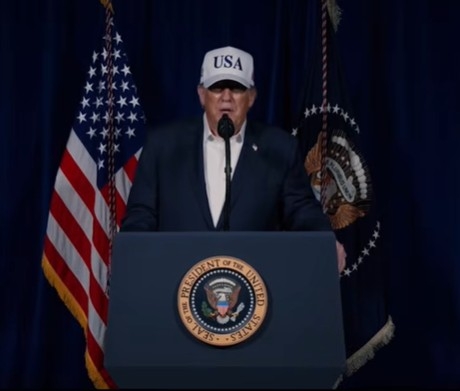
WASHINGTON, DC – INTERNATIONAL condemnation is mounting after United States President Donald Trump confirmed that Iran’s Supreme Leader, Ayatollah Ali Khamenei, is dead following a wave of coordinated airstrikes carried out by the United States and Israel across Iran.
The overnight operation, which reportedly targeted key installations in Tehran and other strategic locations, has left more than 200 people dead, according to initial reports. The strikes were described by US officials as a joint mission between Washington and Tel Aviv, marking a dramatic escalation in tensions between Iran and its long-standing adversaries.
Media reports indicate that Ayatollah Khamenei was the primary target of the operation. The confirmation of his death represents a historic and highly volatile development in Middle Eastern geopolitics.
In swift retaliation, Iran reportedly launched strikes targeting several US military bases across the region, including installations in the United Arab Emirates. Videos circulating online show significant damage to infrastructure in parts of Iran as well as in Bahrain, Kuwait, and Qatar. Reports also indicate that homes, hotels, and other civilian structures were impacted as the situation continues to unfold.
The escalating conflict has triggered widespread diplomatic reaction. Several governments, regional leaders, and international organizations have voiced concern or outright condemnation of the military action from all parties.
In the Caribbean, confusion initially surrounded the position of Trinidad and Tobago. An early statement from the Ministry of Foreign and CARICOM Affairs reportedlyappeared to express support for the US action, stating in part that it “wishes to express its support for the actions of the United States of America.” However, that was withdrawn.
In a follow-up communication, the ministry appeared to adopt a more measured tone, saying it “is closely observing the evolving developments in the Middle East.” The shift in messaging drew attention locally, as citizens and commentators questioned the government’s stance on a conflict with potentially global implications.
Elsewhere, responses were more direct. The Chairperson of the African Union Commission, Mahmoud Ali Youssouf, strongly condemned the strikes. In a statement, Youssouf said, “These actions constitute a clear violation of sovereignty and territorial integrity and risk further destabilizing the Middle East at a time when restraint is urgently required.” He added that the African Union Commission “stands in full solidarity with the governments and peoples of the affected states.”
Youssouf further called for “immediate de-escalation, maximum restraint by all parties, and a swift return to dialogue and diplomacy as the only viable path toward sustainable peace and regional stability.”
The Qatar Embassy in the Dominican Republic also issued a statement on behalf of its leadership, strongly condemning the actions taken and noting that Qatar is working with regional and international partners to address the unfolding crisis.
The developments come against the backdrop of ongoing diplomatic talks between the United States and Iran over uranium enrichment and nuclear capabilities. Those discussions had aimed to ease long-standing tensions surrounding Iran’s nuclear programme, a central flashpoint in relations between Tehran and Western powers for more than a decade. The latest military escalation now casts serious doubt over the future of those negotiations.
At the international level, Antonio Guterres, Secretary-General of the United Nations, condemned the escalation during an emergency meeting of the United Nations Security Council at UN Headquarters in New York on Saturday
“The use of force by the United States and Israel against Iran, and the subsequent retaliation by Iran across the region, undermine international peace and security,” Guterres said.
He reiterated that all Member States “must respect their obligations under international law, including the Charter of the United Nations. The Charter clearly prohibits ‘the threat of the use of force against the territorial integrity or political independence of any state, or in any other manner inconsistent with the Purposes of the United Nations.’”
Against that backdrop, he called for “an immediate cessation of hostilities and de-escalation.”
As the situation remains fluid, analysts warn that the region stands at a critical juncture. The confirmed killing of Iran’s supreme leader, combined with retaliatory strikes across multiple countries, raises fears of a broader regional conflict with global consequences.