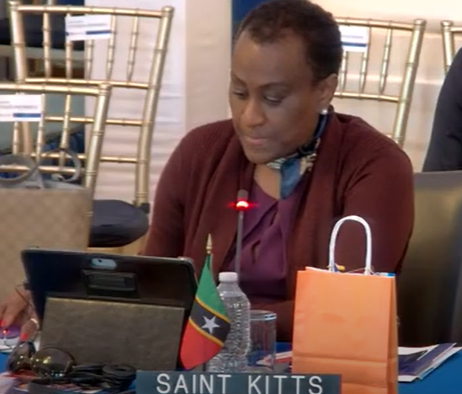
WASHINGTON, DC – ST. Kitts and Nevis has called for strengthened surveillance to better detect and reduce the impact of rare diseases in the Federation and the wider Caribbean.
Speaking on behalf of St. Kitts and Nevis and CARICOM states, the country’s Ambassador to the Organization of American States (OAS), Jacinth Henry-Martin, reaffirmed the region’s commitment to strengthening health and social systems to better support individuals living with rare diseases.
Addressing the OAS Permanent Council during the observance of Rare Disease Day, Ambassador Henry-Martin noted that while rare diseases may affect relatively small numbers of people individually, they present significant challenges for patients, families, and healthcare systems, particularly in small island developing states.
“For St. Kitts and Nevis and CARICOM states, the situation presents both constraints and opportunities,” she said. “Our populations are small and the number of documented rare disease cases remains comparatively limited. Notwithstanding, we acknowledge that low numbers may reflect under-diagnosis, limited access to specialist services, and the fact that some citizens seek diagnosis and treatment overseas.”
Officials stressed that building resilient and equitable health systems remains central to addressing the needs of people living with rare conditions.
In St. Kitts and Nevis, efforts to strengthen primary healthcare and chronic disease management have been guided by national policies aimed at tackling non-communicable diseases (NCDs), which also support individuals with complex medical conditions.
“In this context, strengthening the overall resilience and equity of our health system is central to ensuring that persons living with rare diseases are not left behind,” Henry-Martin said. “In St. Kitts and Nevis, our national focus has been strongly shaped by the heavy burden of non-communicable diseases, leading to the adoption of a National Policy and Action Plan for the Prevention and Control of Non-Communicable Diseases from 2013 to 2017, and subsequently a National Multi-sectoral Plan of Action for the Prevention, Control and Management of NCDs. While these and other measures are not rare disease-specific, they are foundational.”
The government is also working with the Pan American Health Organization (PAHO) and regional academic partners to develop a national health insurance scheme aimed at providing universal access to essential healthcare services and reducing the financial burden on families requiring long-term treatment.
Social protection programmes administered through the National Social Security Fund also provide disability, maternity, child, and survivor benefits to support households affected by illness.
She emphasized the importance of regional and international cooperation given the limited capacity of small states to provide specialised diagnostics and therapies for the more than 6,000 identified rare diseases. Territories within the region rely on partnerships within organizations such as the Organization of American States, the Pan American Health Organization, and the Caribbean Community.
These collaborations, the ambassador reminded, help facilitate medical referrals, telemedicine services, access to medications, and the sharing of critical health data.
Ambassador Henry-Martin stressed that no individual should be disadvantaged because their condition is rare or difficult to diagnose, adding that dignity and human rights must remain central to both global and regional responses.
“On this Rare Disease Day, St. Kitts and Nevis and CARICOM states reaffirm our commitment to building inclusive, resilient health and social systems that serve all people, including those living with rare diseases,” the ambassador stated.
Meanwhile, St. Kitts and Nevis and CARICOM states also used the opportunity to commend Thomas Pascual for his service as Permanent Representative of Chile and Vice Chair of the Permanent Council.
They praised Pascual’s leadership, commitment to dialogue, and efforts to strengthen cooperation within the inter-American system, and wished him success in his future endeavours as he concludes his tenure.