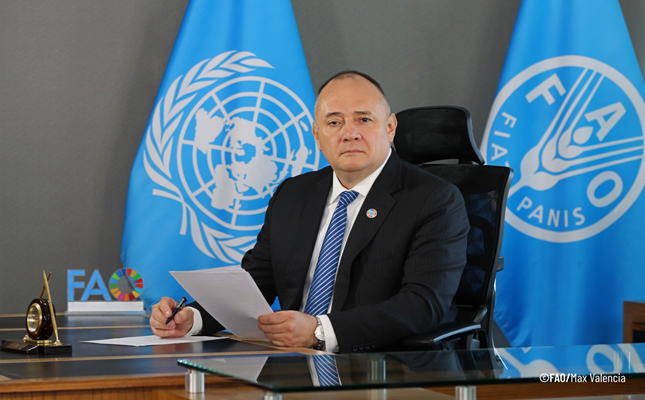
By: Rene Orellana Halkyer, Assistant Director-General and FAO Regional Representative for Latin America and the Caribbean
The designation of 2026 as the International Year of the Woman Farmer by the United Nations General Assembly comes at a decisive moment for Latin America and the Caribbean. The region stands at a turning point to reconfigure its financial ecosystems, in a context marked by increasing climate risks and the need to promote more equitable economic growth. This transformation process will only be complete if women are placed at the center of national development strategies and plans. Ensuring their financial inclusion and strengthening their economic empowerment is an indispensable condition for advancing toward more resilient, sustainable and inclusive agrifood systems.
Women represent 36 percent of the workforce in the region’s agrifood systems. However, they continue to participate under deeply unequal conditions. They face limited access to credit, training processes, financial services and formal markets, as well as a persistent structural burden of unpaid domestic and care work. These conditions limit their economic autonomy, reduce their productivity, and restrict their integration into higher value-added segments of productive value chains.
Advancing gender equality within agrifood systems could generate substantial economic and social impacts, including a significant increase in global Gross Domestic Product and improvements in food security for millions of people. However, a gender perspective continues to occupy a secondary place in development financing flows, and only a limited share of international cooperation incorporates it as a priority objective.
In this context, the 39th FAO Regional Conference for Latin America and the Caribbean represented a starting point to renew commitments for countries to strengthen their political will toward the full participation of rural women and translate it into concrete public policy agreements, financing and innovation.
This entails promoting financial architectures capable of effectively responding to rural realities, articulating instruments such as credit, banking access, insurance and other financial mechanisms with key services, including capacity strengthening, technical assistance, market access, and digital literacy and connectivity.
It is also essential to strengthen the role of rural women’s organizations in all their diversity, through the legal recognition of savings and credit cooperatives and community savings groups as financial intermediaries. At the same time, financial inclusion must be linked to social protection systems, positioning the State as a key actor in providing public guarantees, insurance and mechanisms that facilitate rural women’s access to financial services.
Within this framework, investment in comprehensive care systems constitutes a critical factor in this process. Recognizing unpaid care work and expanding women’s economic participation strengthens household incomes and stimulates local economies. Regional evidence shows that such investments generate social and economic returns, contribute to job creation, and strengthen the resilience of rural communities.
To support these efforts, the FAO-led Regional Platform for the Empowerment of Rural Women has been consolidated as a relevant tool for assisting countries. The platform brings together evidence, good practices, training and cooperation spaces aimed at strengthening the design and implementation of public policies that channel more effective and innovative investments in favor of rural women.
The International Year of the Woman Farmer 2026 calls on governments, the private sector, development banks, international cooperation and civil society to accelerate action by mobilizing investments with a gender-transformative approach and promoting innovation as a driver of agrifood system sustainability.
At FAO, we will continue supporting the transformation of these systems through solid evidence, strategic partnerships and technical assistance to countries, firmly convinced that a hunger-free, more sustainable and inclusive region will only be possible if we strengthen the empowerment of those who sustain food production, rural economies and the resilience of territories across Latin America and the Caribbean.
Disclaimer
This article was posted in its entirety as received by SKNVibes.com. This media house does not correct any spelling or grammatical error within press releases and commentaries. The views expressed therein are not necessarily those of SKNVibes.com, its sponsors or advertisers

 Jamaica News