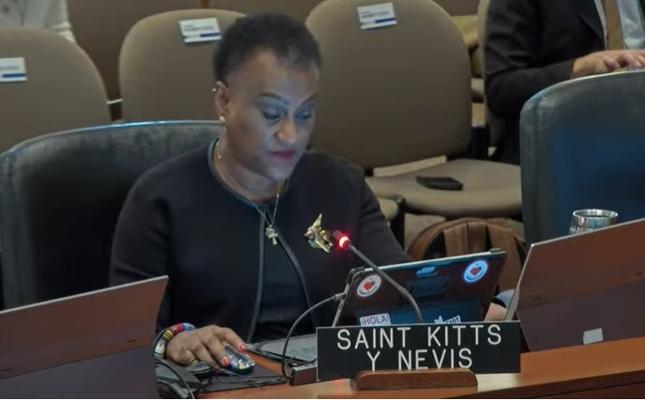
WASHINGTON, DC – ST. KITTS and Nevis has pledged to continue working with regional and international agencies to ensure reparatory justice and greater protection for the rights of people of African descent across the hemisphere, as the Organization of American States (OAS) observes the Ninth Inter-American Week for People of African Descent in the Americas.
Speaking during a meeting of the Permanent Council at the OAS Headquarters in Washington, DC, Ambassador Jacinth Henry-Martin emphasized that the theme, “Equality that Inspires, Freedom that Transforms and a Hemisphere that Leads,” insisting thar it reaffirms the urgency of the shared mission to promote and protect the rights and dignity of people of African descent across the hemisphere.
“For St. Kitts and Nevis, as for many CARICOM states, the transatlantic slave trade and slavery are not mere historical epithets. They are foundational to our societies and continue to shape the structural inequalities we confront today. We are immensely proud that our history also speaks to remarkable resilience, dignity, and the unyielding pursuit of freedom,” she said.
Ambassador Henry-Martin noted that as a nation with a predominantly Afro-descendant population, St. Kitts and Nevis has made progress through inclusive governance, universal education, accessible healthcare, and social protection systems aimed at ensuring opportunity for all.
“Today’s observance is particularly significant as it coincides with the commencement of the Second International Decade for People of African Descent and ongoing negotiations toward an Inter-American Declaration on the Rights of Persons and Peoples of African Descent. These processes reflect a growing hemispheric consciousness that the legacies of slavery, colonialism, and structural racism require not only acknowledgement but sustained and deliberate action,” she noted.
Ambassador Henry-Martin also underscored the importance of the four pillars guiding the discussions, stressing that recognition must go beyond symbolism and include strengthening cultural and social acknowledgement of Afro-descendant peoples, ensuring accurate historical narratives, protecting cultural heritage, and guaranteeing full participation in public life, including equal access to justice.
This, she said, includes engaging in an honest and necessary dialogue on reparatory justice. History reminds us that at the abolition of slavery, compensation was extended to former enslavers for the loss of property, while the enslaved received nothing — no land, n
This profound injustice continues to echo in the inequalities seen today. Within CARICOM, the Reparations Commission and its 10-point plan provide a clear and actionable framework to address these historical wrongs. St. Kitts and Nevis aligns fully with this vision and has established a National Reparations Committee to advance research, public education, and community engagement.
Importantly, this work is not confined to policy spaces. It is shaped by the voices of the people, especially the youth, who are helping to define what a genuine reparative response should look like in society. While development is inseparable from broader global challenges, the experience of St. Kitts and Nevis and many CARICOM states shows that targeted, inclusive, and rights-based policies can meaningfully close historical gaps.
Investments in education, youth empowerment, entrepreneurship, and community development continue to expand opportunity and social mobility. At the same time, the Ambassador highlighted that climate change is also a justice issue, noting that Afro-descendant communities are often among the most vulnerable to its impacts despite contributing the least to its causes.
She emphasized that development strategies must integrate racial equality, sustainability, and climate resilience.
Meanwhile, on gender and intersectionality, she stressed the importance of addressing the specific realities faced by Afro-descendant women and girls, as well as those experiencing multiple and intersecting forms of discrimination.
“Any declaration we adopt must be firmly grounded in a comprehensive, intersectional approach to ensuring inclusion and equity across the board,” she added.
Officials at the OAS in Washington, DC also hosted a number of activities and cultural presentations showcasing African culture, with the week of activities set to wrap up on Friday.