BASSETERRE, St. Kitts — The global economy, already navigating a fragile recovery from the COVID pandemic, is once again under pressure as the fallout from the now-paused conflict in the Middle East continues to ripple across markets worldwide.
The disruption has triggered widespread economic strain, particularly through sharp increases in energy prices and interruptions to critical supply chains. The human toll has also been significant, with millions facing heightened uncertainty as the effects of the conflict stretch far beyond the Middle East.
International financial leaders are expected to confront these challenges head-on at the upcoming International Monetary Fund (IMF) and World Bank (WB) Spring Meetings in Washington, DC, where finance ministers and central bank governors will assess how best to cushion economies and protect vulnerable populations from the latest shock.
Economists describe the crisis as a major global supply shock—one that is large in scale, widespread in impact, and uneven in how it affects different countries. At its peak, the conflict cut global daily oil flows by an estimated 13 percent and liquefied natural gas (LNG) supplies by about 20 percent, sending energy prices soaring.
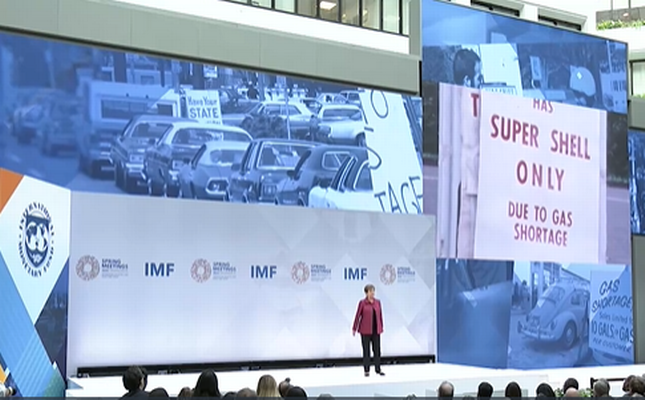
During her presentation at the Curtain Raiser Event at the World Bank on Thursday, IMF's Manging Director Kristalina Georgieva explained that brent crude oil, which stood at approximately $72 per barrel before hostilities began, surged to as high as $120. While prices have since eased, they remain elevated, with many countries still paying premiums to secure essential fuel supplies.
The consequences have been particularly severe for nations at the far end of supply chains, including small island states, where concerns persist over whether fuel shipments will arrive consistently amid ongoing disruptions.
Georgieva noted that beyond energy, the knock-on effects are being felt across several sectors. Food insecurity is worsening, with an estimated 45 million additional people at risk due to transportation challenges—pushing the global number of people facing hunger to more than 360 million. Rising fertilizer costs threaten to compound the issue further in the months ahead.
Industrial supply chains have also been strained, with shortages affecting key materials such as sulfur, helium, and naphtha—critical inputs for everything from semiconductor production to medical imaging and plastics manufacturing.
Analysts warn that the economic impact is unfolding through multiple channels. Higher energy costs are feeding into the prices of everyday goods, driving inflation upward while simultaneously dampening demand. Supply shortages are also constraining production, adding further pressure on economies.
There are also concerns about inflation expectations. Recent data suggest that short-term inflation forecasts in major economies, including the United States and the euro area, have shifted upward, reflecting growing uncertainty. However, longer-term expectations have remained stable—offering some reassurance to policymakers seeking to avoid a prolonged inflation cycle.
As global leaders prepare to meet, the focus will be on coordinated policy responses aimed at stabilizing markets, easing supply bottlenecks, and shielding the most vulnerable from the deepening economic strain.