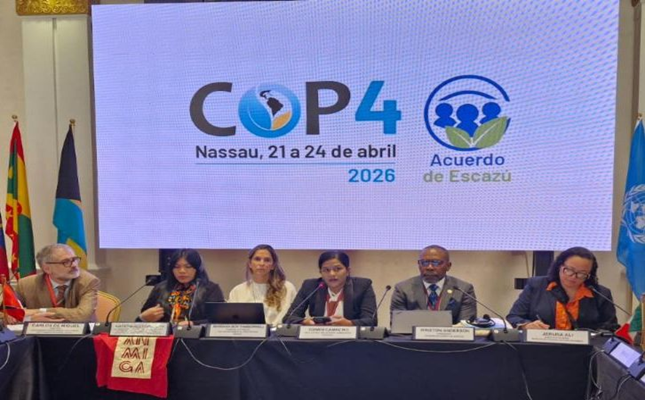
Port of Spain, Trinidad and Tobago -- From 20 to 22 April 2026, the President of the Caribbean Court of Justice (CCJ), the Honourable Mr Justice Winston Anderson, visited The Bahamas to speak on the role of the Escazú Agreement in promoting the rule of law in the Caribbean at the Fourth Meeting of the Conference of the Parties to the Agreement (COP4). COP4 is hosted by the Economic Commission for Latin America and the Caribbean (ECLAC). The Conference is being held for the first time in the Caribbean in Nassau, from 21 to 24 April 2026.
?President Anderson was accompanied by Mr Marlon Prince, officer in the Chambers of the President, and the Honourable Mme Justice Mira Dean-Armorer, Justice of Appeal of the Judiciary of Trinidad and Tobago, in her capacity as Deputy Chair of the CCJ Academy for Law. At its recent 8th Biennial Conference, held in Port of Spain November 2025, the CCJ Academy highlighted the importance of environmental justice to sustainable development.
The Escazú Agreement, adopted on 4 March 2018 in Escazú, Costa Rica, is a landmark regional treaty aimed at advancing environmental rights across Latin America and the Caribbean. It seeks to guarantee access to environmental information, promote public participation in environmental decision-making, and strengthen access to justice in environmental matters.
The concept of the environmental rule of law was first proposed in 2012 by the International Advisory Council to the United Nations Environment Programme, of which President Anderson is a founding member. That same year, the concept was formally recognised by the international community at the United Nations Conference on Sustainable Development in Rio de Janeiro, Brazil. Since then, it has served as a catalyst for governmental and institutional initiatives worldwide to protect and promote environmental interests.
?The environmental rule of law integrates sustainable development within the general rule of law principle. It ensures that environmental laws are clear, enforceable, and applied equitably. Application and implementation frequently involve and are depended on procedural rights.
In reflecting on the significance of the Escazú Agreement at COP4, President Anderson noted that “The procedural guarantees in the Escazú Agreement are not abstract or merely legal commitments; they operate as economic markers and enablers. By shifting access to information, public participation, and access to justice from theory to practice, the Agreement dictates how environmental decisions are made and how risks are measured and shared. The Agreement thus brings the environmental rule of law closer to realization.”
Live streaming of the event is facilitated here: https://live.cepal.org/escazu/.
Disclaimer
This article was posted in its entirety as received by SKNVibes.com. This media house does not correct any spelling or grammatical error within press releases and commentaries. The views expressed therein are not necessarily those of SKNVibes.com, its sponsors or advertisers

 Trinidad & Tobago News