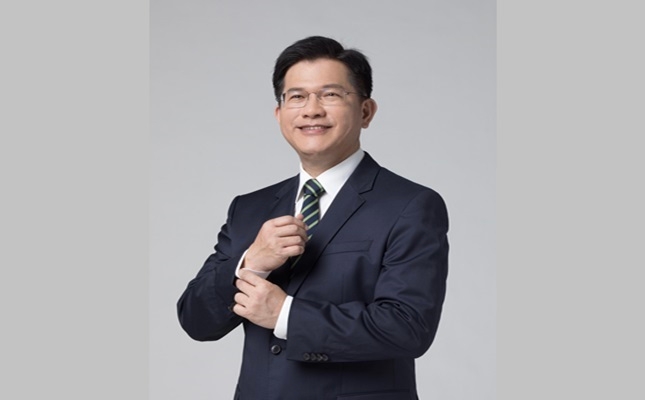
By Dr. Lin Chia-lung
NVIDIA CEO Jensen Huang famously uses a "five-layer cake" analogy to describe the artificial intelligence ecosystem: energy at the base, followed by chips, infrastructure, models, and applications. This architecture illustrates that AI is far more than a software race of chatbots; it is a massive industrial matrix. If any single layer is missing, the entire system collapses.
When we view the U.S.–China race for AI supremacy through this lens, one geopolitical reality comes into sharp focus: Taiwan is the fulcrum upon which the global balance of power tips.
As Mr. Jensen Huang recently remarked: "Taiwan is the center of the AI revolution. Chips, advanced packaging, system assembly, and AI supercomputers are all done in Taiwan." This reality exposes the flaws in some political rhetorics— asserting that "Taiwan stole America's chip industry." Such claims fundamentally misunderstand the profound technological symbiosis that binds the U.S. and Taiwan.
The Tech Symbiosis: Hardware Meets Software
Taiwan’s semiconductor dominance is the result of decades of strategic cultivation—from pioneering research institutions to tech titans like TSMC, MediaTek, and Foxconn. Supported by an elite talent pool and relentless innovation, Taiwan has built a highly specialized, tightly knit ecosystem that cannot be easily replicated. This makes Taiwan an irreplaceable strategic partner for Washington as it strives to build a resilient, "Non-Red Supply Chain" to safeguard national security.
The U.S. has long elevated AI competition to a core national strategy, declaring in its America’s AI Action Plan that Washington must set the global gold standard for AI and eliminate reliance on "adversarial technologies." Yet, to maintain its lead, export controls and software models are not enough. Washington must secure a sustainable physical supply chain, which is precisely where Taiwan's value lies across the AI layers:
- The Chip Layer: The U.S. possesses the world’s strongest chip design capabilities, but designs must be manufactured and packaged at ultra-high yields to become actual AI capacity. Taiwan sits at the nucleus of this loop, producing roughly 90% of the world's AI servers and over 90% of advanced-node chips. American software dominance cannot be realized without Taiwanese hardware.
- The Infrastructure Layer: The U.S. houses hyperscale cloud titans like Microsoft, Google, and Meta. Taiwan commands the comprehensive hardware and ICT supply chain. Merging American platforms with Taiwan’s manufacturing prowess yields the world's most complete AI infrastructure system.
Defending the Democratic AI Frontier
This symbiotic reality is the foundation of the landmark Silicon Age Declaration, signed at the recent U.S.–Taiwan Economic Prosperity Partnership Dialogue (EPPD). Spanning AI supply chain security, digital infrastructure, and high-tech talent, this agreement cements a framework for bilateral economic security.
Crucially, this cooperation extends into the Model Layer. While the U.S. maintains a qualitative lead in cutting-edge models, Beijing is aggressively weaponizing low-cost open-source models across the Global South. The U.S. and Taiwan are actively collaborating on "Sovereign AI" initiatives," ensuring that data security and national sovereignty remain intact prevents the global AI order from being dominated by authoritarian narratives.
The Next Frontier: Physical AI
The ultimate crucible of this tech race will take place at the fifth layer: Physical AI—the integration of AI into robotics, drones, smart manufacturing, and defense. Here, Taiwan faces both unprecedented opportunities and fierce competition.
Taiwan must evolve past its traditional role as a contract manufacturer and actively build a Democratic AI Alliance: weaving together Taiwan’s chips, America’s models, Japan’s robotics, and Europe’s industrial applications. Concurrently, Taiwan must transform its own machine tools, medical devices, and drone sectors into prime testing grounds for Physical AI.
Taiwan's Ministry of Foreign Affairs is aligning its diplomatic and economic strategies to meet this moment—integrating Sovereign AI into the Global Democratic Value Chain, reinforcing drone capabilities in the Indo-Pacific First Island Chain, and securing the global deployment of semiconductors via the Non-Red Supply Chain.
Bound by the "Silicon Age" framework, Taiwan stands as the ultimate pivot point in the U.S.–China AI competition. By helping the United States fully leverage its capital and market dominance while deploying Taiwan's unparalleled supply chain strengths, Taiwan is positioning itself at the vanguard of the next industrial revolution—not just as a supplier, but as an indispensable co-creator of the democratic world's technological future.
The author is the Minister of Foreign Affairs of the Republic of China (Taiwan).
Disclaimer
This article was posted in its entirety as received by SKNVibes.com. This media house does not correct any spelling or grammatical error within press releases and commentaries. The views expressed therein are not necessarily those of SKNVibes.com, its sponsors or advertisers