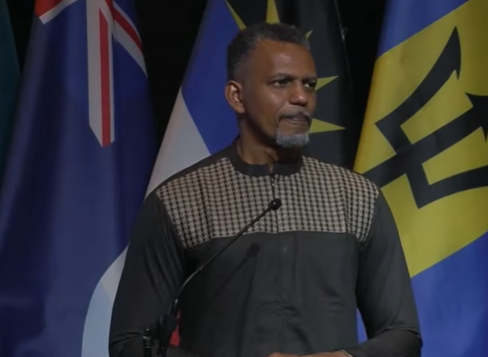
NASSAU, Bahamas – THE Caribbean Development Bank (CDB) has reaffirmed its commitment to addressing the region’s most pressing challenges, pledging to realign its strategies to improve the lives of Caribbean people.
The commitment comes amid growing calls from youth leaders, policymakers, and other stakeholders for the financial institution to place greater emphasis on youth development, skills training, climate resilience, and sustainable economic growth.
From infrastructure development and workforce readiness to geopolitical uncertainty and climate-related threats, the Bank has faced increasing pressure to do more in supporting the region's development agenda.
Speaking at the closing ceremony of the 56th Annual Meeting in Nassau, Bahamas, CDB President Daniel Best acknowledged the concerns raised by stakeholders and regional leaders, noting that the Bank had heard the call from its Governors the young people for a more coordinated approach to development and a faster implementation of its reform agenda and strategic priorities.
Against that backdrop, Best committed the institution to accelerating action, "by aligning our efforts across countries and partners, accelerating decision-making, and deploying practical solutions that translate policy into progress".
“Our focus is to move to implementation to impact, from plans to performance, and to ensure that every action we take delivers meaningful and lasting change for the Caribbean," Best said.
Reflecting on the broader global environment, Best acknowledged that the region continues to face significant challenges, including climate shocks, geopolitical tensions, fiscal constraints, slowing global growth, and the onset of another hurricane season.
“Friends, we arrived this week carrying the weight of a world in flux,” he said. “These realities have not changed, but we continue to approach these challenges with collective purpose. Throughout this meeting, we listened to one another. We exchanged ideas and together we confronted some of the defining questions of our time.”
Best noted that discussions throughout the week focused on strengthening the region’s competitiveness, building resilience, and creating opportunities for future generations. Despite the challenges, he said a common message emerged from the deliberations.
“The future of the Caribbean will not be determined by the challenges we face; it will be determined by the choices we make in response to them,” he stated.
He also recalled remarks made by Bahamian Prime Minister Philip Davis, who urged regional leaders to move beyond merely enduring hardships.“Our goal cannot simply be to survive. Our mission is to thrive,” Best quoted Davis as saying.
According to the CDB President, that philosophy is reflected in the Bank’s 2026-2035 Strategic Plan and was evident throughout the annual meeting.
“At its heart lies a simple proposition: resilience is not an end in itself. Resilience is the foundation upon which prosperity is built,” he said.
Best explained that the Bank remains committed to advancing economic, social, and environmental resilience while placing youth development, climate action, and strong institutions at the centre of its development agenda.
He noted that discussions held in the Impact Room reinforced the reality that sustainable development cannot be financed through public resources alone. Instead, greater efforts are needed to mobilise private investment, strengthen entrepreneurship, and create conditions that support investment-led growth across the region.
Through the EDGEx by CDB initiative, participants also highlighted the growing importance of data, evidence, and knowledge in shaping effective policy and development outcomes.
He stressed the need for countries to invest in stronger data systems, share knowledge across borders, and use locally generated evidence to inform decision-making and accelerate development results.
The discussions on climate finance, he added, reinforced a reality that Caribbean countries know all too well as they continue to grapple with the disproportionate impacts of climate change.