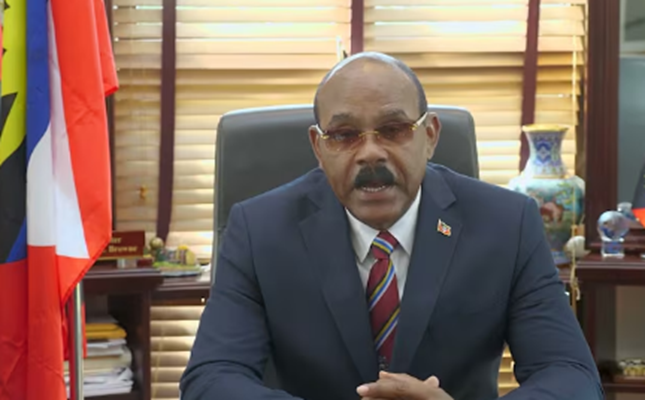
BASSETERRE, St. Kitts – AS the Organisation of Eastern Caribbean States (OECS) celebrates its 45th anniversary, the regional body continues to deliver significant benefits to its member states. However, Antigua and Barbuda's Prime Minister Gaston Browne has highlighted emerging geopolitical challenges that are placing new pressures on the subregion.
From the establishment of the Eastern Caribbean Supreme Court to the Eastern Caribbean Civil Aviation Authority, the OECS has played a key role in advancing regional integration and development. Yet, changing global dynamics are creating fresh concerns for Caribbean leaders.
Addressing the opening ceremony of the 78th OECS Authority Meeting in St. John's, Antigua and Barbuda, Browne spoke candidly about discussions surrounding the acceptance of third-country deportees from the United States.
He noted that the global landscape has changed dramatically over the past 45 years, with the world experiencing what he described as a period of "profound geopolitical recalibration, great power competition, regional wars with global consequences, fragmented supply chains, retreating multilateralism, and the deployment of economic coercion as an instrument of foreign policy."
Touching on the issue of third-country nationals, Browne said, "We have been coerced to take these deportees, encouraged by the great United States. And if we don't cooperate, they punish us. Many of us are resisting to make sure that they do not send us any criminal elements."
The outspoken leader said he had made his government's position clear to U.S. authorities emphasizing that as the Prime Minister of Antigua and Barbuda, he could not willingly cooperate with any other power, any country, "to destroy our beautiful Twin Island state".
He note that the government insisted they will not accept any "criminal elements", and that at the same time limit the amount of individuals who they send to the country.
According to the Prime Minister, an initial proposal would have seen Antigua and Barbuda accept up to 120 individuals. His administration, however, rejected the suggestion, describing it as "unacceptable." Instead, the government counter-proposed accepting no more than 10 individuals annually.
"So, I hope that this will not result in any acrimony and further restrictions, but that they will respect our position and respect our sovereign rights to determine how many of those individuals we accept," Browne said.
The Prime Minister also used the opportunity to highlight broader challenges confronting the region, particularly the rising cost of living.
"Within the region, the issue of cost of living continues to weigh heavily on our people, driven largely by high energy costs and external shocks beyond our control. For small island states, these geopolitical issues, the issue of rising fuel prices and cost of living generally, they are existential," Browne added.