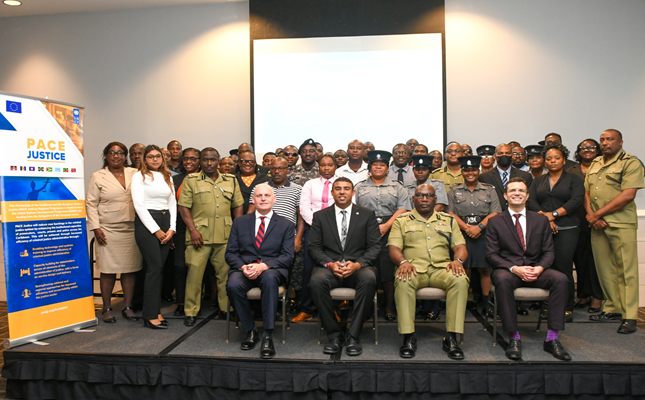
Basseterre, 15 July 2026 -- The Ministry of Justice and Legal Affairs in collaboration with the UNDP PACE Justice Project and UNODC is conducting a four day training programme on the Diversionary Caution System, a key justice sector reform aimed at strengthening accountability, improving proportionality in criminal justice responses, and supporting earlier and more effective intervention in appropriate cases.
The training is being delivered from 13 to 16 July 2026 at Royal St Kitts. The first phase, held from 13 to 14 July, engaged approximately 60 police officers. The second phase, being held from 15 to 16 July, brings together approximately 50 participants from the Judiciary, the Office of the Director of Public Prosecutions, the legal profession, court administration, His Majesty’s Prison, social service agencies, rehabilitation providers, and other justice sector institutions.
The Diversionary Caution System introduces a lawful and structured alternative to prosecution in suitable cases. It is designed to ensure that eligible low level matters can be addressed through timely and proportionate accountability, supported where appropriate by conditions such as reparation, compensation, apology, counselling, rehabilitation, restorative action, education, social support, or other approved interventions.
The framework has a strong restorative and rehabilitative focus. It is intended not only to respond to the offence, but also to address the harm caused, support behavioural change, reduce the likelihood of repeat offending, and promote the successful reintegration of eligible persons into their families and communities.
At the same time, the system preserves prosecution for serious offences, repeat offending, violence, exploitation, and matters requiring the full intervention of the court.
A caution may only be considered where the applicable legal requirements are satisfied, including sufficient evidence, an admission of responsibility, informed consent, and an assessment that diversion is appropriate in the public interest. The framework also provides for victim engagement, formal record keeping, monitoring of conditions, consequences for breach, and continued oversight to support consistency and accountability.
In opening the training for police officers, the Honourable Attorney General Garth Wilkin emphasised that the reform is not about excusing offending, but about ensuring that the justice system applies the right response to the right case. He noted that diversion must operate within a clear legal framework supported by evidence, informed consent, victim considerations, proper record keeping, oversight, and consequences for noncompliance.
The Attorney General further underscored that successful implementation will require disciplined practice and effective coordination across national institutions, including the Police, the Office of the Director of Public Prosecutions, the Judiciary, court administration, legal practitioners, social service agencies, rehabilitation providers, and relevant government ministries.
Deputy Commissioner of Police Cromwell Henry also delivered opening remarks to the police participants. He stated that, “The Diversionary Caution System represents a modern approach to policing and justice. For the Royal St. Christopher and Nevis Police Force, this initiative reinforces our commitment to fair, proportionate, and evidence based policing.” He further highlighted the importance of ensuring that officers understand the legal requirements and operational responsibilities associated with the new framework.
Implementation of the system will also be supported by a national Directory of Programmes and Service Providers. The Directory will assist authorised officers and justice sector institutions in identifying suitable counselling, rehabilitation, restorative, educational, social support, employment readiness, and other programmes capable of supporting the conditions attached to a caution.
This will help ensure that conditions are not merely imposed on paper, but are linked to practical services that can address underlying needs, support accountability, and be properly monitored.
The Ministry of Justice and Legal Affairs acknowledges the significant contribution of the UNDP PACE Justice Project to the development and advancement of the Diversionary Caution System. Through its financial, programme, and institutional support, the Project has assisted the Ministry in moving the reform from policy development toward operational readiness.
The Ministry also acknowledges UNODC, a close and valued technical partner, for its leadership in the design and delivery of the training programme. UNODC has worked closely with the Ministry to adapt the training content to the national legal, institutional, and operational context and to provide practical guidance, advice and support to the police officers and key justice sector institutions.
The combined support of the UNDP PACE Justice Project and UNODC has been instrumental in ensuring that the reform is supported not only by legislation, but also by the institutional knowledge, operational guidance, and coordinated partnerships required for effective implementation.
The Diversionary Caution System forms part of the Government’s broader efforts to modernise the administration of justice, strengthen the rule of law, improve access to justice, reduce unnecessary pressure on the courts, and promote criminal justice responses that are firm, fair, proportionate, restorative, and trusted.
The Ministry of Justice and Legal Affairs expresses its appreciation to all national, regional, and international partners who have contributed to this important justice reform.
Disclaimer
This article was posted in its entirety as received by SKNVibes.com. This media house does not correct any spelling or grammatical error within press releases and commentaries. The views expressed therein are not necessarily those of SKNVibes.com, its sponsors or advertisers