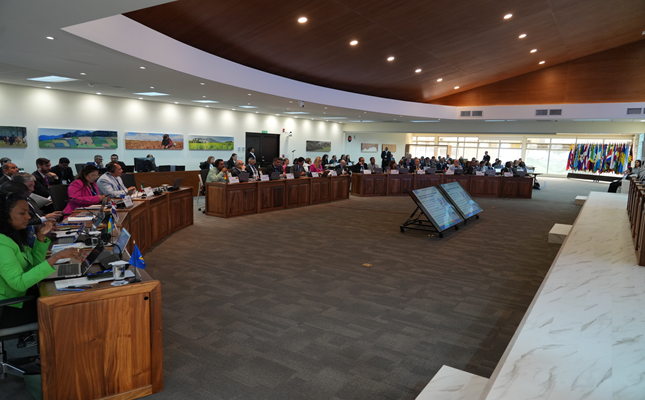
Representatives of the countries stressed that the rules governing agri-food trade must be clear, transparent, and grounded in scientific evidence
San José, 27 July 2026 (IICA) – High-level representatives of countries from across the Americas, meeting at the headquarters of the Inter-American Institute for Cooperation on Agriculture (IICA), stated that measures regulating international food trade must be transparent and science-based.
Accordingly, they expressed concern over the proposed regulation on maximum residue limits (MRLs) for crop protection products currently under discussion in the European Union (EU), warning that it could become a de facto barrier to imports and limit agriculture's contribution to global food security.
The issue was debated and agreed upon by ministers and senior agriculture officials from countries across the hemisphere during the annual meeting of IICA's Executive Committee, one of the Institute's governing bodies, held in San José, Costa Rica.
The resolution adopted raises concerns about regulatory approaches that create unnecessary obstacles to international trade in agri-food products, including the proposal under discussion in the EU, and calls for stronger international cooperation, regulatory transparency, and technical dialogue among countries and international organizations.
The countries of the hemisphere reaffirmed the importance of the rules-based multilateral trading system of the World Trade Organization (WTO). The resolution will be communicated to the WTO by the Chair of IICA's Executive Committee, Roberto Linares, Panama's Minister of Agricultural Development.
If adopted, the regulation could lead exporters to adapt their pest management strategies to EU decisions. Small-scale farmers would be the most affected, as they are the least prepared to cope with rapid changes in production inputs or pest management programs.
The crops facing the greatest risk include bananas, citrus fruits, mangoes, pineapples, peppers, tomatoes, coffee, cocoa, and sugarcane. Soybeans, maize, cotton, and beef could also be adversely affected.
According to the Foreign Agricultural Service of the United States Department of Agriculture, products that could be affected by the proposed approach account for more than USD 5.4 billion in annual U.S. exports to the EU.
More recently, the ministers of agriculture of the Southern Agricultural Council (CAS) also warned that the regulatory initiatives under discussion in the EU could undermine the predictability of international food trade, generate uncertainty, and weaken the coherence of the rules-based multilateral system.
The CAS is composed of Argentina, Bolivia, Brazil, Chile, Paraguay, and Uruguay, with IICA serving as its technical secretariat.
Restrictions on trade
The issue was introduced during the IICA Executive Committee meeting by the delegation of Paraguay.
"Our country, like many others across the hemisphere, produces food for the world that meets multilateral standards of quality, animal and plant health, and food safety. However, our producers continue to face non-tariff barriers that affect exports. These are justified on environmental, sanitary, and phytosanitary grounds, but in most cases they restrict trade more than necessary and are not based on science," warned Paraguay's Ambassador to Costa Rica, Julio Duarte Van Humbeck.
"It is concerning that political arguments are prevailing over scientific ones. This undermines predictability, erodes trust, and has the potential to negatively affect exports from our hemisphere, with serious economic implications," he added.
Paraguay's proposal was supported by the other countries, which agreed that the responsible use of pesticides is a fundamental and necessary tool for addressing pests and diseases and thereby ensuring efficient production systems supported by the adoption of technologies and practices based on scientific knowledge.
"We fully support the resolution. This is not about being confrontational. If our farmers are required to adapt to standards that lack scientific justification, they will face higher costs and greater uncertainty. This is not an abstract debate," said Michelle Bekkering, Deputy Under Secretary for Trade and Foreign Agricultural Affairs at the U.S. Department of Agriculture (USDA).
Mexico's Secretariat of Agriculture and Rural Development also expressed concern over the proposed regulation and its potential impact. "We recognize the European Union's right to update its phytosanitary regulatory framework, provided that it is based on scientific evidence," said Santiago Ruy Sánchez de Orellana, Coordinator for International Affairs.
Cleber Soares, Brazil's Vice Minister of Agriculture and Livestock, stressed that the countries of the Americas are sovereign nations with their own legislation, which must be respected. "It is crucial," he added, "that any measure be based on evidence, as we stated at the recent CAS meeting in Bolivia."
"Like many of IICA's Member States, we are suppliers of food to the EU and share these concerns. This regulation could have undesirable effects not only on trade, but also on food security and on producers' adoption of agricultural innovations. Canada appreciates IICA's efforts to build consensus around rules that are consistent with WTO agreements and the Codex," said Aleksandar Jotanovic, Officer in the Trade Policy Division of Canada's Ministry of Agriculture and Agri-Food.
Disclaimer
This article was posted in its entirety as received by SKNVibes.com. This media house does not correct any spelling or grammatical error within press releases and commentaries. The views expressed therein are not necessarily those of SKNVibes.com, its sponsors or advertisers