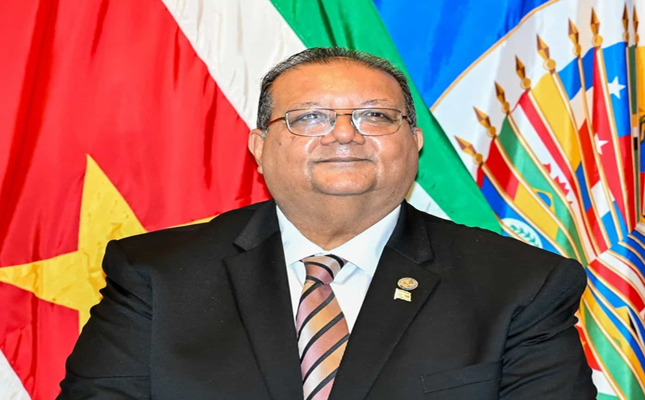
WASHINGTON, DC — AS the Organization of American States (OAS) observes World Day Against Trafficking in Persons, Suriname’s Permanent Representative to the OAS, Ambassador Marlon Faisal Mohamed-Hoesien, has called for greater focus on addressing the challenges that continue to fuel human trafficking across the region.
Speaking during a sitting of the OAS Permanent Council at its headquarters in Washington, DC, Ambassador Mohamed-Hoesien highlighted the vulnerabilities facing Caribbean countries while commending efforts being made throughout the region to combat trafficking in persons.
In his capacity as Chair of the CARICOM Caucus, the Surinamese diplomat said the occasion provided an opportunity to recognise the work being undertaken across the hemisphere, particularly within the OAS, to strengthen cooperation in addressing the issue.
“Human trafficking, whether it is for sexual exploitation, forced labour or any other form of modern-day slavery, represents a grave violation of the human rights of our people and should not be ignored, tolerated or underestimated,” he said.
The Ambassador noted that within the Caribbean, the problem is intensified by porous maritime borders and economic vulnerabilities, which have contributed to the region becoming a transit point and destination for trafficking networks.
He stressed that eliminating human trafficking requires a coordinated approach that targets individuals and businesses involved in the crime, closes legislative gaps, and provides long-term support and protection for survivors.
“For our small island and low-lying coastal states, the rapid digitalisation of our economies has outpaced our regulatory frameworks, opening a vacuum that transnational criminal networks are aggressively exploiting,” he said.
Mohamed-Hoesien warned that the region is not only confronting traditional forms of trafficking but also a growing threat through digital platforms, where criminals exploit technology to recruit and target vulnerable individuals.
“Criminal syndicates use online platforms to bypass physical borders, transforming the internet into a marketplace where the most vulnerable among us can be sold to the highest bidder,” he said.
He added that poverty, inequality, migration, violence, and the impacts of natural disasters and climate-related displacement have increased the vulnerability of citizens across the region.
The Ambassador pointed specifically to the growing threat of online exploitation, noting that women and children are disproportionately affected through online recruitment, grooming, and other forms of abuse.
He said regional authorities are taking steps to educate the public and provide stronger protective measures, while recognising the role of organisations such as the Caribbean Coalition Against Trafficking in Persons in bringing together governments, law enforcement agencies, and civil society groups to combat trafficking networks.
Mohamed-Hoesien also emphasised the importance of cybersecurity, describing it as a critical component of the region’s broader security framework.
He called on regional and international partners to strengthen collaboration and take concrete steps to combat human trafficking in all its forms.