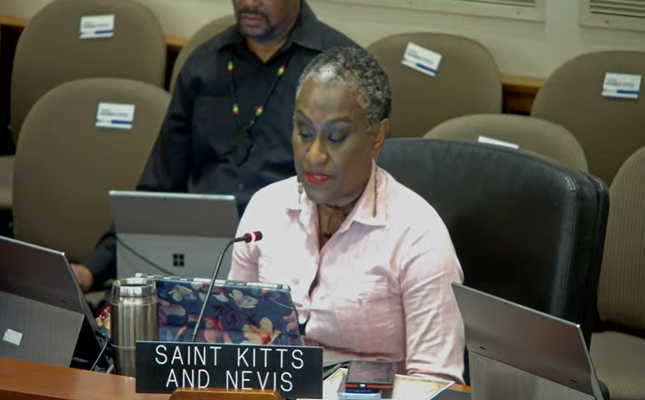
WASHINGTON, DC — ST. Kitts and Nevis joined countries across the Americas in calling for greater recognition, protection and respect for the rights and contributions of Indigenous peoples.
The appeal was made today (Aug. 12) during a special meeting of the Permanent Council of the Organization of American States (OAS), held as part of a week of activities marking the International Day of the World's Indigenous Peoples.
Addressing the Council, St. Kitts and Nevis' Permanent Representative to the OAS, Ambassador Jacinth Henry-Martin, said Indigenous peoples are not simply part of the region's past but remain central to its future through their knowledge, culture and values.
"Indigenous peoples are not merely part of the history of the Americas. Their knowledge, cultures, values and descendants remain integral to its present and indispensable to its future. While the presence of Indigenous peoples in their numbers in St. Kitts and Nevis has become part of the history of ancestors of centuries past, for the people of St. Kitts and Nevis, this theme still resonates, still has particularly powerful sting to the essence of its truth," she said.
The meeting was held under the theme "Roots that Sustain, Knowledge that Transforms, Rights, Water, Health, Culture and Innovation for a Shared Future."
Henry-Martin said the theme reflects a shared reality across the hemisphere and highlighted the Indigenous heritage of St. Kitts and Nevis.
She noted that long before the Federation received its present-day name, the Kalinago people knew the islands as Liamuiga, meaning fertile land, for St. Kitts, and Oualie, meaning land of beautiful waters, for Nevis.
"These names are a precious gift of memory, reflective of the theme in their specific, powerful, symbolism of importance of land and water for health, the preservation of culture, and as drivers of growth, innovation and sustainability in a shared future."
The ambassador said that by continuing to use the names Liamuiga and Oualie, the people of St. Kitts and Nevis acknowledge that the nation's story did not begin with colonisation.
"We honour those who knew these islands before us, who named them, lived from them, understood their waters and landscapes, and left an inheritance that remains woven into the collective identity of the Americas."
She said those names connect present and future generations to the country's natural heritage and serve as a reminder that language, culture and memory can survive even the greatest disruptions in history.
Henry-Martin also paid tribute to the lasting contributions of Indigenous peoples across the Americas, including the preservation of languages, biodiversity, agricultural practices, traditional approaches to health and community life, and environmental stewardship.
However, she stressed that recognition alone is not enough.
St. Kitts and Nevis, the ambassador noted, supports stronger protection of the individual and collective rights of Indigenous peoples throughout the hemisphere, including the preservation of their cultural identity and heritage, meaningful participation in decision-making, freedom from discrimination, and the right to shape the future of their communities.
With the region facing growing challenges from climate change, water insecurity and biodiversity loss, Henry-Martin said the knowledge preserved by Indigenous communities over generations should be embraced rather than marginalised or appropriated.
She pointed to the American Declaration on the Rights of Indigenous Peoples as an important framework for the hemisphere, adding that governments must ensure its principles are reflected not only in policy declarations but also in the daily lives of Indigenous communities.
Henry-Martin urged countries across the Americas to honour Indigenous peoples by protecting their rights and amplifying their voices.