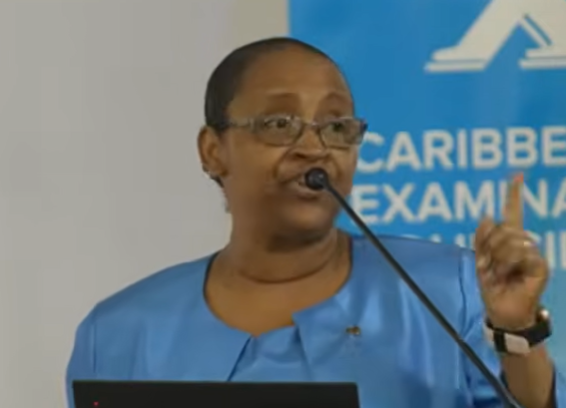
BASSETERRE, St Kitts – THE Caribbean Examinations Council (CXC) continues to grapple with examination irregularities, with the number of reported cases rising significantly during this year’s May-June sitting.
CXC’s Director of Operations, Dr Nicole Manning, said 128 cases of irregularities were recorded this year, up from 80 last year.
Providing an update on this year’s examination results in Anguilla, Manning said the largest category involved the use of unauthorised devices, followed by collusion among candidates and the use of unauthorised materials, including the use of Artifical Intelliegnce
Manning said the emergence of AI-related misconduct is a new challenge for the Council and one that requires greater attention as the technology becomes more widely used.
“We have never had this before," she noted. "This is new. So it is critical for us to understand that similarly like we did in terms of the AI policy framework and happily to know that Anguilla has done their own national policy, the Caribbean Examination Council did a standards and guidelines for the use of artificial intelligence in our assessments and more so generally across.”
Manning stressed that examination irregularities can have serious consequences for candidates, including the cancellation of grades or disqualification, noting that the issue is not limited to isolated incidents where some candidates have repeatedly committed similar violations across different examinations.
According to Manning, “irregularities mean that a candidate for whatever reason may have entered an exam and conducted themselves in an inappropriate manner. That can be disrupting, unruly behaviour, the use of a cell phone, can be anything”.
The issue of irregularities was among several concerns highlighted by CXC this year, including a high level of absenteeism.
Nearly 36,000 candidates were absent from CAPE and CSEC examinations during the May-June sitting.
Manning told the gathering in Anguilla that 3,534 candidates were absent from the Caribbean Advanced Proficiency Examination (CAPE), while 32,403 were absent from the Caribbean Secondary Education Certificate (CSEC).
“A candidate who is absent has no opportunity to be graded because they have missed a component and cannot be graded. So that candidate would have lost out on that opportunity,” she stated.
Manning said the high rate of absenteeism should concern education systems across the region and called on parents, guardians and educators to do more to encourage students to attend their examinations.
“It is something that the Caribbean Examinations Council is concerned about and we are working very hard to encourage our candidates to turn up.”
CXC surveys have found that some students choose not to sit examinations because they feel unprepared, and Manning urged students not to use a lack of preparation as a reason to stay away.
She also reminded that CXC provides compassionate consideration for candidates who are unable to complete examinations because of circumstances such as medical conditions or the death of a loved one.
This year, 359 candidates received support under those arrangements. “So that means that these candidates were not disadvantaged in any way even though they experienced some issue in their lives," Manning noted.