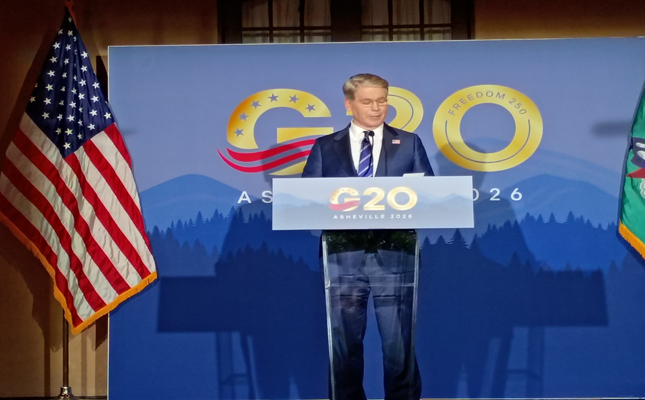
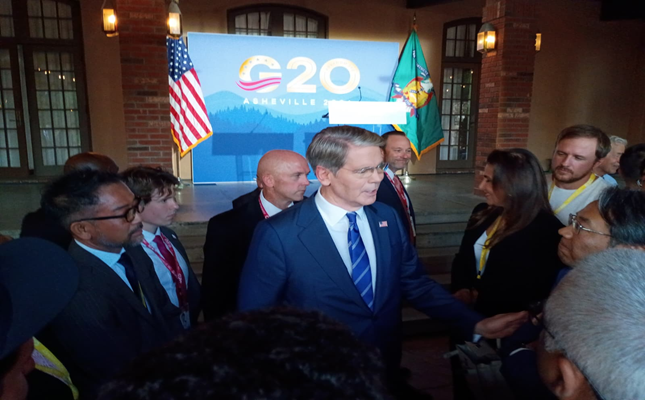
ASHEVILLE, North Carolina — THE escalating conflict between the United States and Iran is casting a long shadow over the G20 Finance Ministers Meeting, as finance ministers and central bank governors assess growing risks to the global economy.
The meeting comes at a critical time, with renewed fighting in the Middle East pushing energy prices higher and raising fresh concerns about inflation, economic growth and the potential impact on oil-importing countries, including those in the Caribbean.
The United States has also stepped up pressure on financial institutions and governments to sever economic ties with Iran, as Washington intensifies sanctions against the Iranian regime.
During the opening plenary session of the G20 Finance Ministers Meeting in Asheville, US Treasury Secretary Scott Bessent thanked the European Union and the European Central Bank for what he described as their “strong statement of support for our economic operations against the Iranian regime.”
The Donald Trump administration in Washington, DC has also threatened additional sanctions against institutions accused of supporting Iran or continuing business with the country.
Against that backdrop, concerns have once again gripped the international community as the United States and Iran have resumed military exchanges in the Middle East.
The United States has said Iran was preparing to launch attacks and place mines in the Strait of Hormuz, a critical global oil shipping route. Tehran has responded with strikes, further escalating tensions in the region.
The developments have already sent oil prices higher, renewing concerns about the cost of fuel and its wider impact on consumers and businesses.
For small, heavily import-dependent economies such as St. Kitts and Nevis, higher global energy prices can quickly translate into increased transportation, electricity and other costs.
Both the Federal Government in Basseterre and the Nevis Island Administration in Charlestown have been grappling with the economic fallout from the geopolitical tensions and rising energy costs.
During a recent press conference, Nevis Premier Mark Brantley acknowledged growing complaints from consumers about higher electricity bills.
With the conflict now six months old and having started after the Nevis Island Administration passed its budget, the local government has moved to introduce measures aimed at cushioning the impact on consumers.
Beginning in June 2026, residential consumers saw the reimposition of a fuel surcharge. However, the government capped the surcharge at 10 cents below the usual rate of 79 cents for residential customers.
Brantley said the feedback from residents has been mixed, but the majority have reported feeling the impact of higher electricity costs.
“Everywhere we go, people are complaining that the cost has significantly increased for most of them,” he said.
“Interestingly, in a very few, a very few cases, they’ve said they have not noticed any increase or any significant increase. But for the majority of persons, they have indicated that they’ve seen a significant increase.”
Against that backdrop, Brantley has urged consumers to conserve electricity as the government continues to monitor developments in the global energy market.
Meanwhile, in St. Kitts, the Federal Government is also pursuing measures aimed at cushioning households and businesses from the impact of higher fuel and energy prices.
The discussions at the G20 meeting therefore carry significance beyond the world's largest economies. Decisions taken by finance ministers and central bank governors on energy security, inflation, sanctions and global financial stability could have a direct impact on smaller economies already facing high import costs.
The G20 Finance Ministers Meeting in Asheville is scheduled to conclude on Tuesday evening.