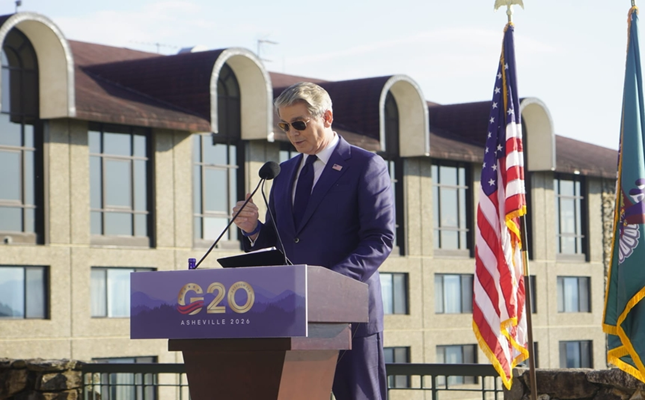
ASHEVILLE, North Carolina — AS the United States and Iran continue to trade fire in the Middle East, Washington is intensifying efforts to isolate Tehran from the global financial system, hoping economic pressure will force Iran to the negotiating table and bring an end to the six-month-old conflict.
The latest escalation comes as the United States steps up military operations against Iranian targets, including missile-launching sites and other strategic infrastructure.
Speaking to reporters at the White House on Wednesday, US President Donald Trump said American forces had maintained strong control over Iran, claiming that US strikes had knocked out Iranian radar capabilities and other military assets.
“We hit them last night because they took a shot at us in Jordan, and we knocked all of them down,” Trump said.
At the same time, the Trump administration has been increasing pressure on Iran’s Islamic Revolutionary Guard Corps (IRGC), which Washington regards as a central component of the Iranian military and security establishment.
The economic campaign has included new sanctions and appeals to US allies, banks and other financial institutions to cut business ties with Iran.
That strategy became a major issue during this week’s meeting of G20 finance ministers and central bank governors in Asheville, where US Treasury Secretary Scott Bessent sought greater international cooperation in restricting Iran’s access to international finance and ensuring freedom of navigation through the strategically important Strait of Hormuz.
Bessent said China, despite being a major economic partner of Iran, had agreed that maritime trade through the Strait of Hormuz must remain open.
China has maintained close economic ties with Iran, particularly in the energy sector, and remains a major buyer of Iranian oil.
Bessent argued that Beijing has a role to play in helping to bring an end to the conflict, saying China could assist through intelligence-sharing, economic intelligence and engagement with entities supporting the Iranian government.
“What I can tell you is that many of our allies came forward and said we will do whatever is necessary because they understand that Iran is in an economic death throes,” Bessent said.
He compared the campaign against Iran to cutting off the head of a snake, arguing that once the country’s remaining economic capacity is sufficiently weakened, its leadership would eventually be forced to negotiate.
Bessent also sought to counter suggestions that China’s continued purchase of Iranian oil was undermining US efforts.
He said Iran currently has about 30 million barrels of crude oil on the water and explained that Chinese purchases are largely settled in Chinese yuan, or RMB. According to Bessent, Washington is therefore targeting the financial channels that allow those funds to be converted and moved through the region.
He pointed to sanctions against banks and financial institutions, including a Dubai-based institution targeted by the United States, as part of efforts to prevent Iran from accessing dollars and other international currencies.
“When that money cannot be converted to dollars, then the regime will starve,” Bessent said. But the economic pressure on Iran is also being felt far beyond the Middle East.
The renewed fighting has pushed oil prices higher, raising concerns about fuel costs and the broader impact on consumers, businesses and import-dependent economies.
For countries such as St. Kitts and Nevis and other Caribbean states, higher global energy prices can quickly translate into increased transportation, electricity and other operating costs.
Both the Federal Government in Basseterre and the Nevis Island Administration have been grappling with the fallout from rising energy prices.
Nevis Premier Mark Brantley recently acknowledged growing complaints from residents over higher electricity bills as the conflict entered its sixth month.
Beginning in June 2026, residential consumers saw the reintroduction of a fuel surcharge. However, the administration capped the charge at 10 cents below the usual residential rate of 79 cents.
Brantley said feedback from residents has been mixed, but acknowledged that most consumers are feeling the impact of higher electricity costs.
As Washington presses ahead with its campaign to squeeze Iran economically, the effects of the conflict are therefore extending beyond the battlefield, with energy-dependent countries and consumers around the world continuing to bear part of the cost.