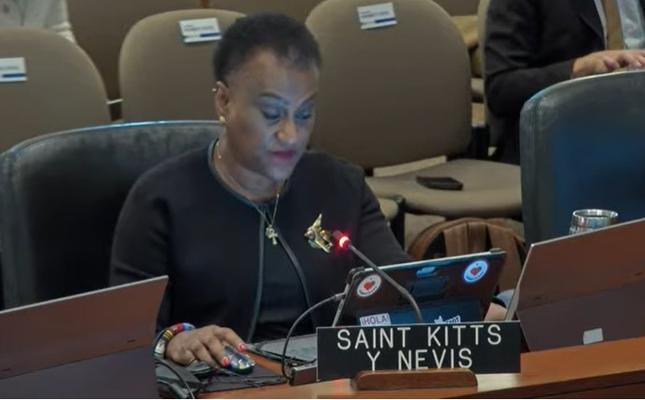
WASHINGTON, DC – AS the Federation continues its push to become a more sustainable developing state, its plans and priorities were again highlighted at an international forum.
St. Kitts and Nevis’ Ambassador to the Organization of American States (OAS), Jacinth Henry-Martin, recently addressed a sitting of the Inter-American Council for Integral Development (CIDI), providing representatives from across the hemisphere with an update on the Federation’s sustainable development agenda.
She explained that the country has developed a national Sustainable Island State Agenda (SISA), which sets out where St. Kitts and Nevis wants to be by 2040.
Henry-Martin said investments are already being made in critical areas, including renewable energy, water security, climate-smart agriculture, resilient housing, health infrastructure and the circular economy, as the Federation seeks to make better use of its limited resources.
Since taking office in 2022, Prime Minister Dr. Terrance Drew and his administration have made the SISA agenda a priority. In simple terms, the initiative is aimed at helping the Federation become more self-sufficient and resilient in key areas as the geopolitical environment shifts
“So for us, the conversation is about how partnerships can help us move more quickly from ambition to implementation to realization,” Henry-Martin told the Council.
The ambassador stressed that one of the areas where small developing states need the most support is in closing the gap between plans and implementation, noting that this support does not always have to come in the form of financing.
“It can mean access to technology, specialised technical expertise, project preparation, institutional partnerships, and where financing is required, finding innovative and appropriately structured instruments that work for small developing states.
“We would ask our partners to look beyond per capita income when assessing need. It bears repeating that for small island developing states such as St Kitts and Nevis, a single external shock can have an economy-wide impact, while the per capita cost of building resilient infrastructure is disproportionately high.”
Henry-Martin’s presentation forms part of the Federation’s broader effort to build international partnerships around the SISA agenda and secure the technical, institutional and financial support needed to achieve its 2040 goals.