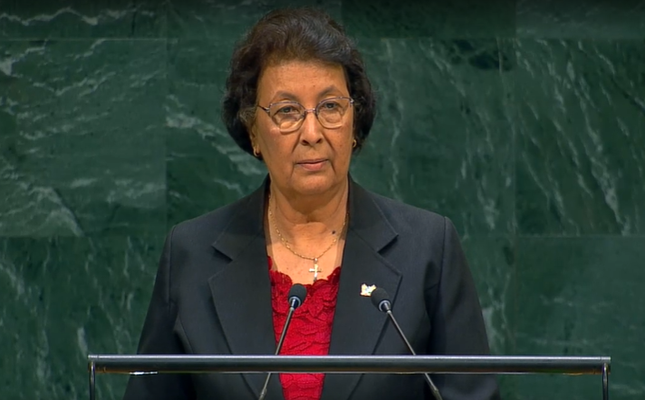
MANHATTAN, New York – SURINAME is calling for renewed efforts to transform and strengthen the United Nations, arguing that reform is necessary to restore confidence in the organisation’s ability to deliver peace, inclusion and sustainable development.
The call came from Suriname’s President Jennifer Geerlings-Simons during the ongoing General Debate of the United Nations General Assembly.
She said countries, particularly vulnerable and developing states, depend on a rules-based international order and must be able to rely on international law.
Geerlings-Simons committed Suriname to the “upholding of international law”, stressing that “as we depend on a rule based international order without which, like many other vulnerable nations, we simply cannot exist as sovereign countries.”
“The consistent application of international law and the strengthening of its institutions is also essential to maintain international peace and security, protect human rights and ensure sustainable development for all,” she added.
Her remarks came as the international community continues to grapple with armed conflicts, rising geopolitical tensions and their effects on food and energy security.
“Mr. President, as mentioned before, the international community is experiencing profound uncertainty, including energy and food security crises, leading to intensified displacement of many people globally,” she said.
She pointed to the continued loss of civilian lives in armed conflicts, saying children are being exposed to “unimaginable horrors” as geopolitical tensions continue to rise.
The Surinamese leader also highlighted the wider economic consequences of conflicts, including developments in the Strait of Hormuz, which she said demonstrate how quickly wars can affect energy markets.
“Other developments, for example in the Strait of Hormuz, demonstrate how quickly wars can affect energy markets suddenly and steeply, increasing the cost of energy, adversely impacting economic and social development in our countries,” she said.
“Common people suffer when food and energy prices rise, so the quality of life of our people is directly threatened, even by wars in regions far from their homes.”
Against this backdrop, Geerlings-Simons called for a renewed commitment to the principles of the UN Charter, including the peaceful resolution of disputes.
“Dialogue is paramount for safeguarding a solid and proven UN system,” she said.
Cuba and Haiti
The Surinamese president also addressed the situation in Cuba, calling for continued dialogue and negotiations to prevent further escalation.
“Suriname calls on the parties involved to remain committed to dialogue and negotiation to end the economic, commercial and financial embargo,” she said.
“We plead for continuing negotiations in order to prevent further escalation and to reach a resolution that will benefit the people of Cuba.”
She also called for sustained international support for Haiti as efforts continue to restore security, constitutional order and democratic governance.
“Suriname supports solutions that place the Haitian people at the center,” she said.
Call for UN and Security Council reform
Geerlings-Simons further backed reforms aimed at improving the efficiency and effectiveness of the United Nations.
She said the UN80 reform process, which focuses on mandates, rationalisation, institutional coherence and efficiency, should strengthen the organisation’s ability to deliver rather than reduce support where it is most needed.
The president also renewed Suriname’s support for reform of the UN Security Council.
She said the Council should become more representative, accountable and capable of responding to international challenges.
Suriname also supports Africa’s longstanding call for permanent representation on the Security Council, while advocating for greater representation of small island and low-lying coastal developing states.
Regional cooperation
Geerlings-Simons said regional and international partnerships remain important to Suriname’s economic and social development.
She highlighted the country’s participation in regional organisations and mechanisms, including CARICOM, CELAC, ACTO and the Brasilia process, as Suriname prepares to assume the chairmanship of CARICOM in 2027.
She said Suriname will continue strengthening partnerships in areas including food and energy security, climate resilience, connectivity, the movement of skilled people, and the transportation of goods and services.
“These are essential to economic integration and our ability to withstand external shocks,” she said.
Reparations and the legacy of slavery
The Surinamese president also addressed the issue of restorative justice and reparations for slavery and the transatlantic trafficking of enslaved Africans.
She pointed to the adoption earlier this year of a UN resolution on the issue, saying it has given new momentum to discussions on reparations.
The issue, she argued, is particularly relevant to Suriname and countries across the Caribbean.
“The discussion is no longer about whether slavery and colonialism have caused lasting consequences, negative consequences,” Geerlings-Simons said.
“We know we are living them.”
She said the focus must now shift toward determining how those effects can be addressed and what form reparations should take.
“And on the question of what form reparations should take to achieve that,” she said.
“How countries that have benefited from slavery and colonialism will compensate the effect.
“That is the important issue now.”