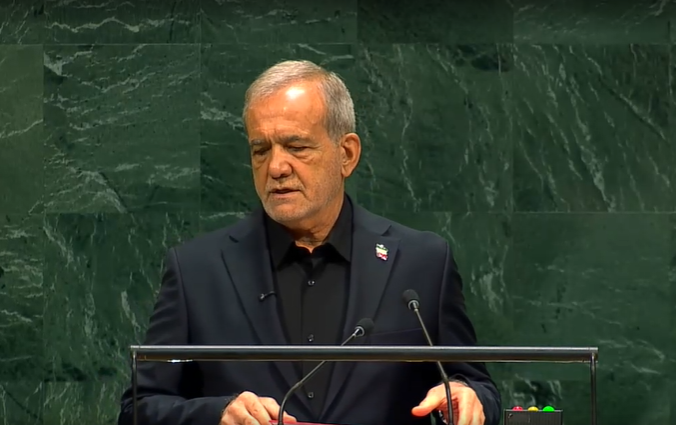
MANHATTAN, New York – IRAN is showing no sign of backing down amid escalating tensions with the United States and Israel, with President Masoud Pezeshkian defending his country’s right to respond to attacks and rejecting Washington’s characterization of Iran as a terrorist state.
Pezeshkian made the remarks during his address to the United Nations General Assembly on Wednesday (Sept. 23), a day after US President Donald Trump issued a strong warning to Iran’s leadership and described them as “terrorist” during his own UN address in New York.
Pezeshkian used his speech to highlight the human cost of the conflict, pointing to the killing of Iran’s Supreme Leader and attacks on schools, hospitals and other infrastructure as examples of what he described as unlawful actions by the United States and Israel.
“I come from an Iran where, in truth, they bombed a school. You see these children? These children perished under bombs, with weapons used by the United States and Israel. They were innocent, had committed no crimes,” he said.
He also accused the United States of using weapons with multiple warheads during an attack in Lamerd, where he said a sports hall containing children was struck.
“They martyred, assassinated, our scientists, our men, women, and children. Innocent children who, in truth, had committed no crimes, no sins,” Pezeshkian said.
He rejected the description of Iran as a terrorist state and maintained that Tehran’s actions were defensive.
“Those who are terrorists and train and protect terrorists describe us as such. We have only defended ourselves. We are not terrorists,” Pezeshkian added.
Pezeshkian said Iran had come under sustained attacks but insisted that the country had remained defiant. “Yes, they did hit us, but we did not bend the knee. We did not bow our head. We responded, but we did not hit civilian populations.”
He accused the United States and Israel of targeting Iranian universities, healthcare facilities, schools, hospitals and other infrastructure, which he said violated international law.
The Iranian president also referred to the assassination of Hamas political leader Ismail Haniyeh in Tehran, saying it occurred when he was assuming the responsibilities of president.
Turning to the wider regional conflict, Pezeshkian accused Israel of committing genocide in Gaza and said more than 80,000 civilians had been killed and hundreds of thousands displaced.
He questioned Iran’s portrayal as a source of regional instability while arguing that his country was seeking independence and the ability to defend itself.
Pezeshkian argued that Iran needs military strength to deter further attacks, but said that strength was intended for defence rather than aggression.
“Iran must be powerful so as to avoid being threatened, to avoid its future being threatened,” he said. “We do not seek power in order to attack or commit aggression. We seek energy for progress, not to threaten societies with weapons.”
He also said Iran would not seek permission from other countries to defend itself.
On Iran’s nuclear programme, he defended the country’s right to pursue nuclear technology and rejected the international pressure and sanctions that have been imposed over the years.
His comments come as tensions between Tehran and Washington remain high, with the conflict continuing to draw international concern and condemnation over the humanitarian and security consequences.
Pezeshkian defended Iran by insisting that the country’s military capabilities were intended to prevent attacks on its cities from going unanswered, while maintaining that Tehran does not seek to base its security on the insecurity of other nations.