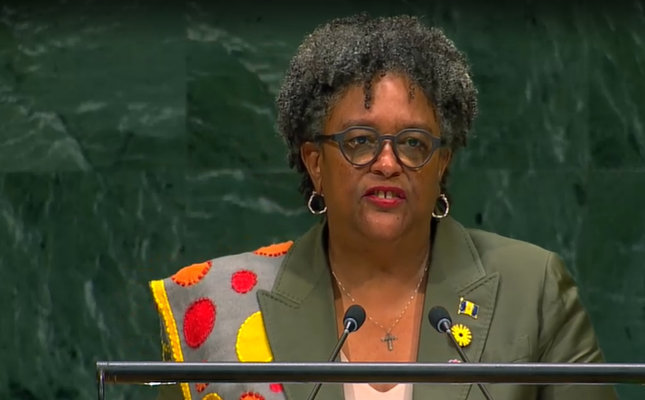
MANHATTAN, New York – AMID growing climate challenges facing developing states ahead of the 31st Conference of the Parties (COP31), Barbados Prime Minister Mia Mottley has underscored the need for the international community to move beyond simply setting goals and focus on implementation.
During her presentation at the ongoing United Nations General Assembly General Debate, Mottley highlighted rising global temperatures and extreme weather events, pointing to the sweltering conditions experienced across Europe and concerns about the potential impact of a super El Niño.
Mottley, along with several other world leaders, used the General Debate to challenge developed countries to do more to address climate change, including providing financing to help vulnerable states tackle the growing effects of climate change.
The prime minister said the proposed action agenda for COP31 places methane reduction at the centre of climate implementation, describing the focus as particularly important for small island states.
“It is true that carbon dioxide must remain central to the global energy transition, but emissions are not falling quickly enough, and the full benefits of action will take time to emerge,” she said.
“So, Mr. President, under Barbados's presidency of the CVF, Climate Vulnerable Forum, and its G20 countries, 74 countries got together and advanced the call to pull the methane emergency brake at the G20 Ministerial Dialogue in April of this year.”
Mottley said finance ministers agreed that methane reduction must be treated not only as an environmental priority, but also as an economic, fiscal and public health opportunity.
Turning to financing, Mottley said vulnerable countries need to mobilise approximately US$490 billion annually by 2030, while current inflows stand at roughly US$90 billion.
“As young people in Barbados would say, ‘the math simply ain't math’,” she said.
She also called for action to address the borrowing costs faced by climate-vulnerable countries, noting that these costs are almost 1.2 percentage points higher than those faced by advanced economies.
“Now that figure seems small to you, but that actually generates an estimated $62 billion more a year in excess interest payments each year,” Mottley said. “This cannot be fair!”
She said Barbados and its partners have demonstrated that change is possible through initiatives developed under the Bridgetown Initiative.
Mottley pointed to the Vulnerability to Viability Compact, which was designed and launched by the Climate Vulnerable Forum, G20 countries and the OPEC Fund for International Development.
The initiative brings together 74 countries and 16 development finance institutions with the aim of expanding access to affordable, long-term capital for education, health and water infrastructure projects.
The CVF has also brought together central bank governors to establish the Lifeline Fund, which Mottley said will soon be operational.
The fund is intended to provide rapid liquidity when climate shocks create balance-of-payments pressures for vulnerable countries.
“So we are moving to help ourselves,” she said.
“We have been resolute, and the reason for it is that we know that you cannot build hospitals and schools and water infrastructure with 10- and 15-year money. It crowds out critical investments for our people and leaves you flat-footed.”
Mottley said the initiatives represent real progress, but warned that such mechanisms cannot, on their own, address the underlying weaknesses in the international financial architecture.
“I repeat that for almost five years, the Bridgetown Initiative has consistently argued that climate resilience, debt sustainability and access to affordable finance cannot be treated separately,” she said.
She added that for many vulnerable countries, the challenge is not simply the availability of capital, but whether they have sufficient fiscal space to borrow and invest on reasonable terms.