Citizens and residents of St. Kitts and Nevis are urged to keep their eyes peeled, and to report sightings of “Cheeks”, a male brown pelican who was rescued and rehabilitated by the St. Kitts Sea Turtle Monitoring Network (SKSTMN) and Ross University School of Veterinary Medicine (RUSVM).
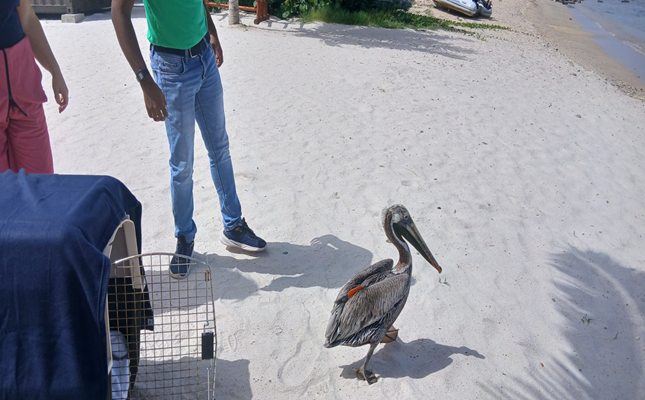
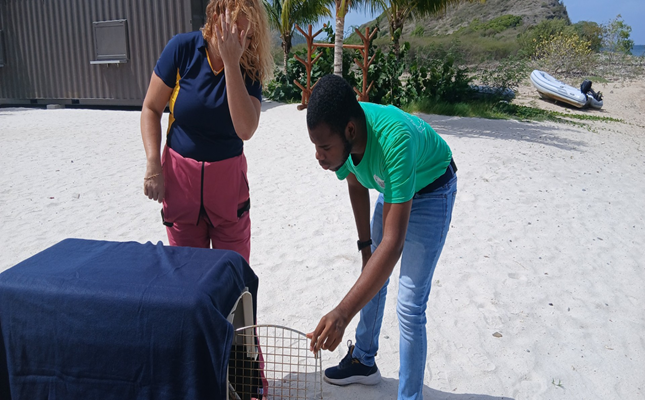
“Cheeks” was so named by its caregivers, because of his endearing cheeky antics while undergoing treatment over the past month. He was found stranded in the Villa Vista area of Frigate Bay and then reported to the St. Kitts Sea Turtle Hotline. On presentation he was weak, thin, and dehydrated with some proprioceptive deficits. He was in rehabilitative care for one month during which time he regained his strength and 0.7 kilograms. He was released in the area of Whitehouse Bay on the Southeastern Peninsula on 11 September 2026.
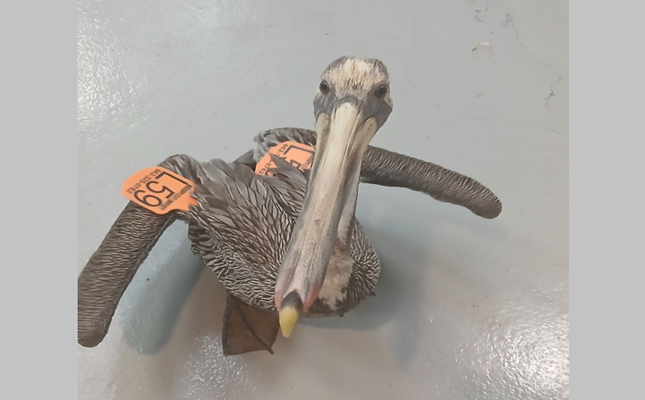
A juvenile bird, “Cheeks” can be identified by the two orange patagial tags placed on his wings (see image) that read L59. These tags will enable the rehabilitation team, birdwatchers, and residents to continue monitoring his progress in the wild to gain valuable information on his movements. The patagial tags and training for placement were donated and overseen by Scott Rush, PhD, MS, BS, an associate professor at Mississippi State University’s Forest and Wildlife Research Center.
The Whitehouse Bay area is located near to a pelican rookery on the same side of the island, and has open, unpopulated spaces for normal behaviors, with ready access to other pelicans with which “Cheeks” would be able to integrate, and he was seen doing so shortly after release. As pelicans are wild animals and it is critical that they maintain wariness of humans for their own protection, they should be respectfully observed from a distance. If you have binoculars or a scope you can look carefully for the patagial tags. They are also relatively visible without the aid of these items as they are orange and located on the upper side of the wings. If you spot “Cheeks”, please let the SKSTMN know by calling the St. Kitts Sea Turtle Hotline at (869) 764-6664 or emailing them at skturtles@gmail.com. Also, if you need to report a pelican that is in danger or injured you can reach out to the St. Kitts Sea Turtle Hotline number as well.
The brown pelican (Pelecanus occidentalis) is the national bird of St. Kitts and Nevis and is referred to as a booby locally. Adults are dark gray to brown with white around the head and neck. Immature pelicans are gray to brown above and on the neck, with a whiter underside. They can reach up to eight pounds and have wing spans of over seven feet. Their primary diet is composed of small schooling fish such as menhaden, mullet, and herring. They are able to spot fish at distances of 70 feet in the air, and they then dive headfirst into the water column to acquire them. They face threats from human disturbance, pollution, fishing gear, overfishing which reduces their food supply, climate change, and handouts. While it may be tempting to throw fish parts out for them, sharp bones can puncture their throat pouches or stomachs and larger scraps can get stuck in their throats and lead to starvation, so it is always best to allow them to forage on their own.
For more information on how you can become involved in wildlife rehabilitation in St. Kitts and Nevis please reach out to the SKSTMN at skturtles@gmail.com and read more about the SKSTMN at stkittsturtles.org.
Disclaimer
This article was posted in its entirety as received by SKNVibes.com. This media house does not correct any spelling or grammatical error within press releases and commentaries. The views expressed therein are not necessarily those of SKNVibes.com, its sponsors or advertisers