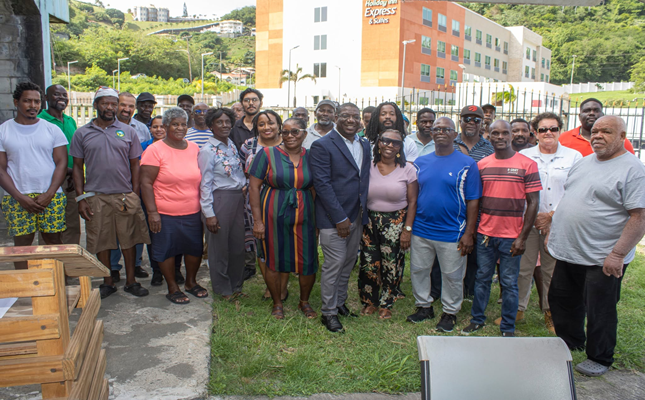
Kingstown, Saint Vincent and the Grenadines – 8 October 2026 – The Food and Agriculture Organization of the United Nations (FAO), in close collaboration with the Ministry of Agriculture, Forestry, Fisheries, Rural Transformation, Industry and Labour, handed over solar ferti-irrigation packages to 20 hot pepper farmers at a ceremony held at the VincyFresh Ltd., compound, Diamond Industrial Estate, as part of the ongoing hot pepper value chain pilot programme that began in 2024.
The handover fulfils a commitment under the FAO project Building Effective Public-Private Partnerships for Production and Marketing of Sustainable Agricultural Products, to equip pilot farmers with the tools needed to improve productivity and consistency of supply. Each package included a solar-powered pump and solar panel, plastic mulch, drip lines, water tanks and supporting components, enabling farmers to irrigate their crops using a fertigation system that applies water and nutrients together. Farmers are also expected to receive water soluble fertilizers, and hot pepper seedlings before the end of October.
Minister of Agriculture, Hon. Israel Bruce praised the hot pepper farmers for their resilience and said he looks forward to further conversations with industry stakeholders on developing the sector. Minister Bruce also spoke to the phased approach taken to the rollout, noting that it was designed deliberately so that increased production would not outpace what the market could absorb, protecting farmers from the kind of glut that could drive down prices. He linked the initiative to the Ministry's recent work to strengthen market access for hot pepper farmers, including Memoranda of Understanding signed to open new trading opportunities in the United States of America.
Speaking on the broader strategy behind the handover, FAO Trade and Markets Officer, Mr. Juan Cheaz situated the intervention within a wider, holistic approach to upgrading the value chain. “This handover reflects a holistic approach that puts appropriate technology in the hands of farmers alongside the training and inputs they need to grow. As we strengthen production, we also have to keep an eye on the market side, making sure farmers are positioned to meet the growing demand for hot pepper, both locally and in export markets.”
The handover builds on a series of training sessions delivered by FAO Hot Pepper Specialist, Mr Luke Lee, who worked with extension officers, plant nursery care workers and farmers on comprehensive training covering land preparation, seedling management, integrated pest and disease management, irrigation, post-harvest handling, and fertigation system installation.
Following the training, FAO also handed over hot pepper monitoring kits in July to the Ministry of Agriculture, equipping extension officers with the tools needed to support farmers through early detection of pests and diseases in the field. Strengthened monitoring capacity is expected to allow the Ministry to respond more quickly to emerging pest and disease pressures, helping to reduce crop losses.
To improve the genetic diversity and heat profile of the hot pepper grown locally, FAO also supplied seeds, which were imported from Trinidad and propagated at the Orange Hill and Dumbarton agriculture stations. The seeds showed a high success rate of germination and to date twelve beneficiary farmers have planted in the first round, while five of them already harvested.
Leeward farmer, Mr Ashford Charles, a beneficiary of the training and input package, said, "The training and practical sessions were very beneficial to my hot pepper production. The irrigation and fertigation system we learned about was especially useful, like the venturi system made it much easier to irrigate the crops while supplying nutrients to the plants at the same time, and it was simple to implement. The recommended plant spacing also made a real difference. I got a good quantity of peppers for the number of plants I had, and the quality of what I harvested was very good."
Mr Osborne Miller, who began growing hot peppers for the first time following the training, and handover of inputs said: "I had grown sweet peppers before, but I had never grown hot peppers until this training. The sessions were very beneficial, and the information and techniques I learned were really useful as I got started with hot pepper production."
Through continued investment in irrigation infrastructure, planting material, technology and technical training, FAO and the Ministry of Agriculture continue to support the growth of a more productive and market-ready hot pepper value chain in Saint Vincent and the Grenadines.
Disclaimer
This article was posted in its entirety as received by SKNVibes.com. This media house does not correct any spelling or grammatical error within press releases and commentaries. The views expressed therein are not necessarily those of SKNVibes.com, its sponsors or advertisers

 St. Vincent News