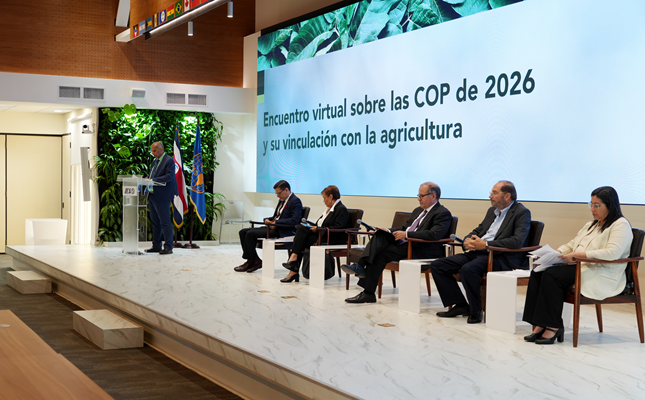
San José, 16 October 2026 (IICA) – Federations of agrifood entities throughout the hemisphere ratified their partnership with the Inter-American Institute for Cooperation on Agriculture (IICA) to ensure that the positions of the productive and agroindustrial sector would be heard and have an impact at major global environmental conferences.
Authorities of the hemispheric organization and representatives of the entrepreneurial sector stressed that food production, environmental conservation, and rural development should not be seen as incompatible objectives but rather as components of a shared agenda. They also agreed that the time had come to discuss reforms to the Conferences of the Parties (COPs) of the United Nations Convention relating to the environment, in a bid to strengthen their performance and avoid excess use of resources.
The debate took place during a meeting organized by IICA and FECAGRO. This year’s session, COP 31, will take place next month in Türkiye. Moreover, two other major environmental discussion forums are also being held in 2026.
Indeed, COP17 of the United Nations Convention to Combat Desertification already took place in August in Mongolia and COP17 of the Convention on Biological Diversity will be held this month in Armenia. These conferences are held every two years. The three environmental conventions were all adopted during the 1992 Earth Summit in Rio de Janeiro.
The IICA-FECAGRO meeting—which was an in-person and virtual session—was organized to discuss how to strengthen the position and influence of the agriculture sector of the Americas in the COP meetings, since the decisions of these forums impact agricultural activity and the international food trade. The event provided an opportunity to reaffirm the need to strengthen public and private sector partnerships and to demonstrate that agricultural production and agroindustry are essential for the food security, stability, and prosperity of the hemisphere.
Moreover, the participants stressed that consensus positions on environmental matters that are forged at COP are transcendental, given that they will then inform public policies that impact agricultural activity in the countries and result in mandatory commitments by countries that are parties to these conventions.
During the meeting, IICA reaffirmed its commitment to continue working together with countries and farmers to find solutions to environmental impacts, which pose tremendous challenges for agricultural production. Participants also underscored the need to accelerate the achievement of funding commitments aimed at enhancing adaptation to more challenging weather conditions.
Mobilizing resources and driving innovation
IICA Director General Muhammad Ibrahim noted that collaboration between the public and private sectors is crucial to promote the use of biotechnology in the region’s agriculture sector, improve competitiveness, and address challenges such as the conservation of natural resources—all of which require coordination, trust, and joint efforts.
He also called for examining how COPs are operating and discussing ways in which they could be restructured to achieve greater synergy and avoid fragmentation.
He stated: “The questions we must answer are: How many decisions made at the COPs are actually being implemented, and what metrics are being used to assess progress toward environmental goals?”
Francisco González, of Costa Rica’s National Agricultural and Agroindustry Chamber (CNAA) and former President of FECAGRO, noted that “for those of us in agriculture, environmental sustainability is a fundamental condition for ensuring continuity and competitiveness. We promote the efficient management of natural resources, but we must also achieve productivity and profitability. We must be economically viable and socially sustainable. The sector must generate jobs, attract investment, and offer opportunities for development.”
González added that the agriculture sector advocates for science-based regulations, open trade without unnecessary barriers, access to new technologies, the strengthening of agricultural health, and the sustainable management of water, soil, forests, and biodiversity.
Keith Currie, an eighth-generation family farmer who serves as President of the Canadian Farmers’ Federation (CFA), emphasized that food production is facing times of uncertainty, not only due to weather conditions, but also due to disruptions in trade and value chains. “IICA can play a central role in environmental forums, by spotlighting these issues and driving a shift that has already started to take shape in recent COPs,” he stated.
For his part, Felipe Spaniol, speaking on behalf of the Brazilian Agriculture and Livestock Confederation (CNA), noted that it is crucial for the interests of the agriculture sector to be defended and called for a unified stance from governments: “We must ensure that the ministries of Agriculture and the Environment attend the COPs with shared work goals,” he remarked.
The purpose of the meeting was to discuss how to strengthen the position and influence of the agriculture sector of the Americas in the COP meetings, given that the decisions of these forums impact agricultural activity and the international food trade.
Disclaimer
This article was posted in its entirety as received by SKNVibes.com. This media house does not correct any spelling or grammatical error within press releases and commentaries. The views expressed therein are not necessarily those of SKNVibes.com, its sponsors or advertisers