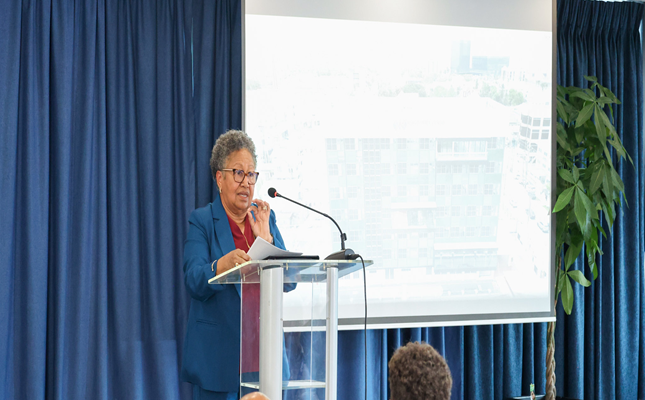
"Dr. Barnett spoke of the Region’s investment opportunities at the opening of the World Trade Centre Georgetown International Trade and Investment Conference, where she emphasised the importance of investments that expand production, strengthen regional value chains, support innovation and create employment."
CARICOM Secretariat | Turkeyen, Greater Georgetown, Guyana | Tuesday, 20 October 2026: CARICOM Secretary-General Dr. Carla Barnett on Monday highlighted investment opportunities across several sectors in the Region, including agriculture and agribusiness, renewable energy, tourism, transportation and communications.
Dr. Barnett spoke of the Region’s investment opportunities at the opening of the World Trade Centre Georgetown International Trade and Investment Conference, where she emphasised the importance of investments that expand production, strengthen regional value chains, support innovation and create employment.
“There are clear opportunities for investment across the Community. Agriculture and agribusiness remain important as we work to expand food production and strengthen processing, storage, distribution and regional value chains. Renewable energy can improve energy security and reduce production costs. Tourism remains a major internationally traded service, with scope to deepen its linkages to agriculture, culture, transportation, technology and other sectors. Transportation, logistics and communications are themselves important areas for investment and essential enablers of regional commerce.
In her address, she encouraged businesses and investors in the audience to consider CARICOM through both a national and a regional lens, pointing out that each Member State “offers its own opportunities and comparative advantages. At the same time, as we work to strengthen the economic connections among our markets, we create a wider platform for production, trade and investment.”
Please listen to the Secretary-General’s remarks here.
Please read Dr. Barnett’s remarks below:
Good morning.
It is a pleasure to join you for the Opening Ceremony of the World Trade Centre Georgetown International Trade and Investment Conference.
This Conference is taking place as the international environment is becoming considerably uncertain. The multilateral trading system, underpinned by multilateral rules, agreed in the context of the World Trade Organisation, is under significant pressure. Changing tariffs and other trade measures are affecting market conditions. Supply chains are being reconfigured. Conflict in the Middle East and disruption around major shipping routes are sharply increasing shipping and energy costs resulting in rising prices across the globe. We are certainly experiencing sharply rising prices across the Caribbean.
Global trade is still growing, and that is important. But it is doing so in a more fragmented and for small, open economies such as ours, that matters immensely.
The Caribbean Community’s (CARICOM) trade performance over the past five years has seen merchandise exports increasing from about US$19 billion to more than US$39 billion. Imports also rose, to around US$42.9 billion in 2025, but export growth was stronger. As a result, the merchandise trade deficit narrowed substantially from levels exceeding US$10 billion in earlier years to approximately US$2.6 billion and US$3.3 billion in 2024 and 2025, respectively.
That improvement is notable, but its composition also matters. Much of the export growth has been driven by energy and commodities. CARICOM continues to import a large share of its food, manufactured goods and capital equipment. The challenge, therefore, is not only to increase exports, but to broaden the productive base from which those exports come.
Services present a similar picture. CARICOM is a net exporter of services, with a services trade surplus of more than US$7.2 billion in 2024. Services exports recovered well from the pandemic period, but travel accounted for about 82 per cent of total services exports in 2024. While that is a major strength, it also points to the importance of ensuring greater diversification.
Investment flows remain relatively modest. CARICOM and the wider Caribbean attracted approximately US$4 billion in inward foreign direct investment in both 2024 and 2025, accounting for only a small share of total inflows to Latin America and the Caribbean. Those flows also remain concentrated in tourism, real estate, energy and selected services, while greenfield investment remains comparatively weak.
These trends reinforce the long-standing reality that our economies are small, very open and highly concentrated. Amid heightened external uncertainty, regional integration and collective action become even more important.
The Revised Treaty of Chaguaramas provides the principal legal framework for that effort, with overall policy direction from the Conference of Heads of Government of CARICOM. For participating Member States, the CARICOM Single Market and Economy (CSME) is the central instrument through which we seek to widen the economic space available to people and businesses through the movement of goods and services, skills and capital, and through rights of establishment.
Opening markets, however, is only a part of the task. The effective functioning of a regional economy also depends on what we produce; how production is organised across borders; how investment is mobilised; how payments and capital move; how regulatory and tax systems interact; and whether the infrastructure supporting commerce allows firms to compete effectively from anywhere within and across in the Region.
CARICOM has identified four mechanisms to support these processes.
The first is the CARICOM Industrial Policy and Strategy, which seeks to enable strengthening of regional productive capacity, through greater cross-border use of natural resources, skills, capital, technology and management capabilities; and through stronger linkages among firms and sectors. Developing regional enterprises capable of achieving scale; and diversifying production for regional and international markets, are also critical.
The Strategy recognises that competitiveness depends on research, development and innovation, and on production systems that are more sustainable, resilient and responsive to technological change.
The second mechanism is CARICOM’s Investment Policy, which is aimed at improving transparency, predictability and coherence in the investment environment, while recognising the different circumstances and priorities of individual Member States.
The third mechanism is work to deepen regional capital markets and make it easier for capital to reach productive opportunities across the Region.The CARICOM Payments and Settlement System, which is under consideration by the regional central banks, is intended to improve the mechanisms through which cross-border payments can be made and settled. Inefficient payment arrangements add cost, delay and complexity to regional commerce, particularly for smaller firms.
The fourth mechanism is tax coordination. The Intra-CARICOM Double Taxation Agreement seeks to provide greater certainty for income, investment and business activities across national borders, while safeguarding the legitimate tax interests of Member States.
While these may appear to be highly technical areas of work, they have very practical consequences. The effectiveness of regional economic integration ultimately depends on whether businesses can use the arrangements that have been created: whether they can make payments efficiently, access finance, invest across jurisdictions, and operate with sufficient regulatory and tax certainty.
CARICOM is also seeking to strengthen existing and new extra-regional trade relationships. This includes ongoing work to advance discussions and negotiations with close neighbours, such as Colombia, Costa Rica and the Dominican Republic.
The United States remains one of the Community's most important trading partners. While we welcomed the restoration of the Caribbean Basin Initiative preferences after the temporary Section 122 tariffs expired in July, we recognise that other trade measures continue to affect particular products and Member States. These developments underline the need for continued engagement and close attention to changing market conditions.
CARICOM is also widening its engagements, with Brazil, India and African Union countries identified among priority markets for greater engagement. This Conference’s dedicated session on Doing Business with Brazil is therefore timely, and provides an opportunity to examine how trade, investment and wider economic relations with Brazil and the wider Latin American region can be expanded.
These external relationships are important, but our ability to benefit from them largely depends on the strength of our own economies. Market access has greatest value when firms have the productive capacity, finance, technology, logistics and scale needed to use it. Regional integration and external economic engagement must therefore reinforce each other.
There are clear opportunities for investment across the Community. Agriculture and agribusiness remain important as we work to expand food production and strengthen processing, storage, distribution and regional value chains. Renewable energy can improve energy security and reduce production costs. Tourism remains a major internationally traded service, with scope to deepen its linkages to agriculture, culture, transportation, technology and other sectors. Transportation, logistics and communications are themselves important areas for investment and essential enablers of regional commerce.
The quality of investment matters as much as the volume. We need investments that expand productive capacity, support innovation and diversification, strengthen regional value chains, and create employment.
I encourage the businesses and investors here today to consider the CARICOM through both a national and a regional lens. Each Member State offers its own opportunities and comparative advantages. At the same time, as we work to strengthen the economic connections among our markets, we create a wider platform for production, trade and investment.
Government and Regional Institutions can put frameworks in place, but it is the private sector which makes them work. As businesses use the arrangements being developed, we learn where practical constraints remain that can and must be addressed, so that investments flow into the productive opportunities that will grow our economies and thereby improve the quality of life for citizens across the Caribbean Community.
Thank you.
Disclaimer
This article was posted in its entirety as received by SKNVibes.com. This media house does not correct any spelling or grammatical error within press releases and commentaries. The views expressed therein are not necessarily those of SKNVibes.com, its sponsors or advertisers

 Guyana News