WASHINGTON, DC — AS he prepares to bring his decade-long tenure as United Nations Secretary-General to a close, António Guterres has reflected on his responsibility to speak candidly about the climate crisis, insisting that scientific facts must remain at the centre of global efforts to address the growing threat.
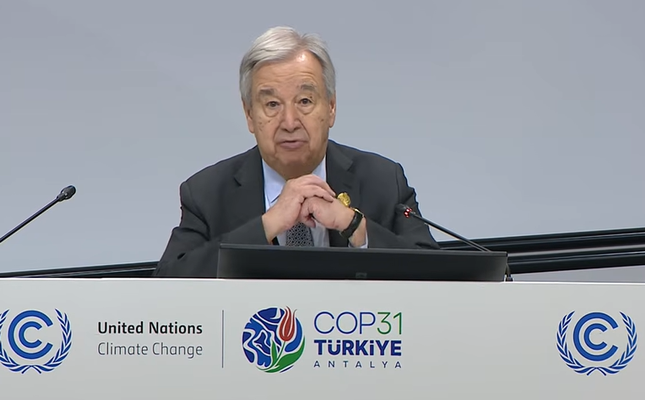
Speaking to reporters during a press conference in Antalya, Türkiye, on Friday (Nov. 13) morning, Guterres said that throughout his 10 years as Secretary-General, he had consistently sought to tell the truth about climate change, even when doing so made some uncomfortable.
He maintained that his responsibility was never to make the facts more convenient for world leaders or the international community, but rather to present the scientific realities, particularly when those realities were difficult to confront.
“Facts are facts,” the Secretary-General added.
During what marked his final climate conference as UN chief, Guterres underscored the far-reaching consequences of climate change, noting that its effects extend well beyond environmental concerns and are increasingly undermining global development, economic stability and international security.
He pointed to the growing impact of climate-related disasters on food security and population displacement, warning that vulnerable countries are seeing development gains accumulated over decades rapidly eroded.
“It pushes countries deeper into debt. It aggravates competition for land and water. It fuels instability. And, increasingly, it threatens the very existence of communities and countries,” he said.
For Guterres, climate action has never been an isolated issue but rather one that is directly connected to virtually every aspect of the United Nations' work.
“You cannot build peace on a burning planet. You cannot eradicate poverty when climate disasters keep throwing people back into it," he stated.
“You cannot promise young people a better future while destroying the natural systems on which that future depends. “And you cannot speak seriously about justice when those who did least to cause this crisis suffer first and worst,” he stressed.
His remarks also renewed attention on the plight of Small Island Developing States (SIDS), many of which continue to face rising sea levels, increasingly severe weather events, coastal erosion and other climate-related threats despite contributing relatively little to global greenhouse gas emissions.
For years, Guterres has been among the leading international voices calling on developed nations to honour their climate financing commitments and provide greater support to vulnerable countries, particularly those on the frontline of the crisis.
He also reiterated that the continued dependence on fossil fuels remains at the heart of the problem, arguing that there can be no credible pathway to climate safety without a decisive transition away from them.
“Fossil fuels are driving the climate crisis. There is no credible path to a safe climate without moving away from them,” he declared.
Guterres called for an accelerated transition that is just, orderly and equitable, warning that continued dependence on fossil fuels leaves countries vulnerable to international price shocks, geopolitical tensions and economic instability.
He argued that simply changing suppliers would not address the underlying problem, maintaining that countries must instead reduce their dependence on fossil fuels.
That transition, he said, must involve a substantial expansion of clean energy, electricity grids, energy storage, efficiency and clean electrification, while ensuring that the growth of renewable energy translates into a meaningful reduction in fossil-fuel production, consumption and emissions.
However, the Secretary-General acknowledged that the world faces another difficult reality, with a temporary overshoot of the 1.5-degree Celsius global warming threshold now considered inevitable.
He said the international community must therefore focus on limiting the extent and duration of that overshoot and bringing global temperatures back below the threshold as quickly as possible.
As Guterres prepares to leave office, a new Secretary-General is expected to assume the position next year, inheriting an international organisation facing mounting pressure to deliver meaningful progress on climate action.
For Small Island Developing States, the change in leadership comes at a critical time, as they continue to press for climate justice, stronger international commitments and the financial resources needed to protect their populations and economies from the worsening effects of climate change.
The challenge for Guterres' successor will be to ensure that the warnings repeatedly issued over the past decade translate into concrete action, particularly for countries whose very survival is increasingly threatened by a crisis they did little to create.