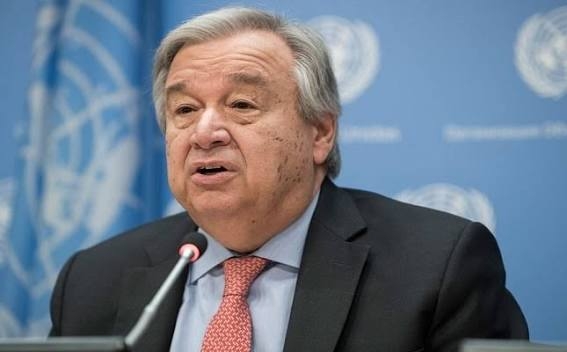
WASHINGTON, DC – UNITED NATIONS Secretary-General António Guterres has renewed his call for a faster transition away from fossil fuels towards renewable energy, warning that developing countries will face increasingly severe climate impacts without greater international support.
Guterres said the current global energy situation, coupled with escalating geopolitical tensions and rising fuel prices, has further exposed the vulnerabilities associated with dependence on fossil fuels.
Speaking ahead of his participation in the ASEAN meeting at a press engagement, the UN chief identified two critical priorities: accelerating the transition to renewable energy and significantly increasing financial assistance to developing countries to strengthen their climate resilience.
“I do believe that there are two things absolutely essential,” Guterres said.
The first, he explained, is to speed up the transition from fossil fuels to renewable energy, arguing that renewable sources are now more affordable and safer alternatives.
“The time of fossil fuel is coming to an end. Today, renewables are cheaper, and at the same time, they are safer,” he said.
Guterres pointed to disruptions and tensions affecting key maritime routes, including the Strait of Hormuz and the Bab el-Mandeb, as examples of how geopolitical instability can have far-reaching consequences for global energy markets and consumers.
He noted that rising prices for petroleum products have placed additional pressure on households, worsening living conditions, while major fossil fuel companies continue to record substantial profits.
According to the Secretary-General, the nine largest fossil fuel companies collectively earned US$95 billion in profits during the first quarter of the year.
He described the situation as fundamentally unfair, arguing that ordinary people are bearing the cost of higher energy prices while major industry players continue to benefit financially.
Guterres also stressed that the transition to renewable energy must be accompanied by greater investment in climate adaptation, particularly in developing countries that are increasingly exposed to extreme weather events.
He warned that global warming exceeding the 1.5-degree Celsius threshold would intensify the effects of storms, typhoons, droughts and flooding, placing additional pressure on vulnerable communities and critical infrastructure.
The UN chief said developed countries must significantly increase their financial contributions to help developing nations prepare for and withstand these impacts.
He has been calling for developed countries to triple their financial support for climate adaptation, but acknowledged that even such an increase would meet only about 30 percent of the estimated requirements.
“We must find ways to multiply the resources available in order to provide developing countries, and particularly in the ASEAN area, with resources that are needed to build resilience,” he said.
He added that countries must be better equipped to protect their populations and infrastructure against worsening climate conditions, particularly with the possibility of a stronger El Niño event adding to existing climate pressures.
Beyond the financial challenges, Guterres identified the influence of the fossil fuel industry as a major obstacle to meaningful climate action.
He argued that political leaders understand the seriousness of the climate crisis but have not done enough to confront powerful industry interests that continue to promote dependence on fossil fuels.
According to Guterres, substantial industry profits, inadequate taxation and organised lobbying have helped sustain the dominance of fossil fuels while contributing to public disinformation about climate science.
He renewed his call for governments to introduce taxes on windfall profits earned by fossil fuel companies, arguing that the industry should contribute more towards addressing the consequences of climate change.
Guterres maintained that governments must take greater responsibility for reducing greenhouse gas emissions and accelerating the transition to cleaner energy sources, rather than allowing industry lobbying to delay progress.
However, he said public opinion and civil society organisations remain important forces in pushing governments to take stronger action.
Reflecting on his participation in the recent Conference of the Parties (COP) climate negotiations, he said he had witnessed a strong demand from people around the world for more decisive government action.
His remarks come amid growing concerns over the ability of developing countries, particularly small and climate-vulnerable states, to finance the infrastructure and adaptation measures needed to withstand increasingly severe climate events.
For many developing nations, the challenge is not simply reducing emissions but securing the financial resources and technical support needed to protect their economies, communities and infrastructure from the effects of a warming planet.