CAF and GEF presented a programme at COP31 that will support Colombia, Panama, the Dominican Republic, Jamaica, Trinidad and Tobago, Grenada and Saint Lucia in strengthening early warning systems, coordinating responses and developing alternatives for the productive use of sargassum
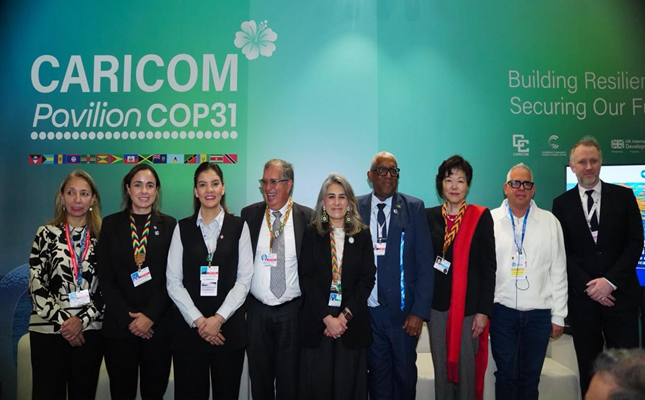
Antalya, Türkiye, November 18, 2026, CAF – Development Bank of Latin America and the Caribbean and the Global Environment Facility (GEF) presented SargMarine at COP31, a regional project financed through a USD 10 million GEF grant to address massive sargassum influxes and reduce their impact on marine and coastal ecosystems, tourism, fisheries and communities across the Greater Caribbean. The presentation of the initiative was also supported by Mexico and France.
The project also envisages USD 67.3 million in co-financing. CAF will serve as the implementing agency, the Organization of American States (OAS) as the executing agency, and the Inter-American Institute for Global Change Research (IAI) as a technical partner. The initiative aims to facilitate information sharing, strengthen countries’ capacity to anticipate and manage sargassum influxes, and develop alternatives for its productive use that can create opportunities for local economies.
“Sargassum is a transboundary phenomenon, but our responses remain largely national. Overcoming this fragmentation requires strengthening existing mechanisms, building on the capacities of regional organizations, and reaching agreements that enable more effective joint action,” said Lina Mondragón, CAF’s Climate Action and Positive Biodiversity Manager.
The scale of the phenomenon requires a response that connects scientific information with public policy decisions and investment. According to the United Nations Environment Programme, 37.5 million tonnes of sargassum were recorded in the Atlantic in May 2025, the highest volume observed since monitoring began in 2011. Massive accumulations affect economic activity in coastal areas and place increasing pressure on ecosystems and community health.
“The initiative has already received final approval. This means it is ready to get underway. We are ready to drive action on the ground,” said Chizuru Aoki, Manager of the GEF’s Conventions and Funds Division.
During the launch of the initiative at COP31, Fabio Arjona Hincapié, Colombia’s Minister of Environment and Sustainable Development, highlighted the need to address sargassum from a regional perspective and strengthen cooperation among affected countries.
“Local solutions definitely will not work on their own,” he said, emphasizing the importance of developing joint responses and strengthening regional and international negotiating capacity to address the phenomenon.
Strengthening the ability to anticipate sargassum influxes was among the priorities highlighted by Matthew Samuda, Jamaica’s Special Envoy for Climate Change, Environment, Oceans and the Blue Economy.
“Jamaica’s priorities are to strengthen monitoring and forecasting. We want to know when it will arrive and where,” he said.
He explained that this information can help determine where protection efforts should be concentrated and support planning for the productive use of sargassum, whose viability also depends on understanding the availability of raw material.
Ana Emilia Pimentel, the Dominican Republic’s Vice Minister for Climate Change and Sustainability, called for responses to the phenomenon to take community needs into account alongside an assessment of its economic consequences.
“We also have to think about this from the perspective of the people,” she said, highlighting the social dimension of a challenge that requires greater cooperation among affected countries.
For Caribbean countries facing increasingly frequent sargassum influxes, SargMarine will help turn regional cooperation into more coordinated monitoring, preparedness and response.
Disclaimer
This article was posted in its entirety as received by SKNVibes.com. This media house does not correct any spelling or grammatical error within press releases and commentaries. The views expressed therein are not necessarily those of SKNVibes.com, its sponsors or advertisers

 Jamaica News