WASHINGTON, DC -- WOMEN and girls continue to face growing threats in an increasingly digital world, with cyberbullying, online harassment and the misuse of emerging technologies creating new avenues for intimidation, exploitation and abuse.
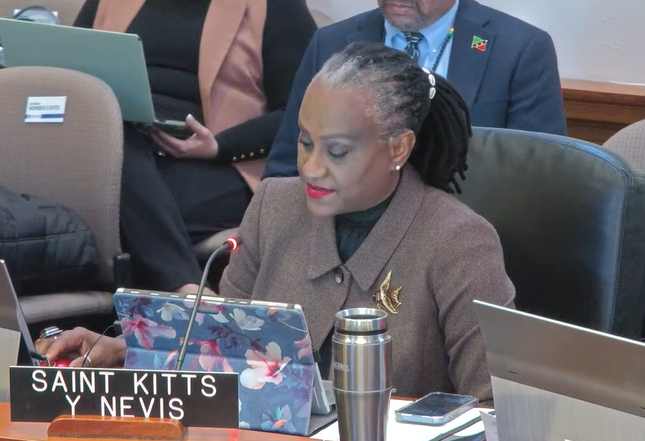
The Federation’s Ambassador to the Organization of American States (OAS), Jacinth Henry-Martin, recently addressed the issue during a special sitting of the Permanent Council of the hemispheric body, where she called for greater attention to the impact of technology-facilitated violence against women and girls.
She explained that while the expansion of digital platforms has created new opportunities for communication, education and economic participation, it has also been accompanied by the “proliferation of new instruments of intimidation, exploitation and violence against women and girls”.
“Technology has transformed how we communicate, learn, conduct business and participate in public life. Yet the very platforms intended to expand opportunity are being weaponised to threaten women's dignity, undermine their security and silence their voices,” the ambassador said.
The issue has attracted growing international concern as women and girls increasingly face abuse through online platforms and other digital channels.
The United Nations has warned that the rapid expansion of the digital world, while bringing significant benefits through greater connectivity, education and economic opportunities, has also created new avenues for gender-based violence to develop and spread.
A 2024 report by the UN Regional Information Centre for Western Europe, citing global studies, noted that between 16 and 58 per cent of women and girls have experienced online violence.
“Online harassment, cyber stalking, threats, the non-consensual dissemination of intimate images and increasingly sophisticated forms of artificial intelligence enabled abuse are neither trivial offences nor harmless manifestations of online behaviour. The consequences are real, devastating and frequently enduring. They inflict psychological harm, compromise personal security, undermine livelihoods and discourage women from exercising their rightful place in public and political life,” Ambassador Henry-Martin told the Council.
“We must be unequivocal,” she said, stressing that violence does not become less reprehensible because it is perpetuated through a screen, nor should the protection of fundamental rights diminish at the boundaries of the digital world.
For the Latin America and Caribbean region, Henry-Martin said the issue requires broader regional attention. She pointed to estimates by UN Women that approximately one in three women in the region has experienced physical and/or sexual violence during her lifetime.
While acknowledging that the statistic covers violence beyond the digital sphere, she argued that it highlights “the deeply entrenched inequalities and patterns of abuse that technology can now amplify”.
Turning to St. Kitts and Nevis, the ambassador said confronting technology-facilitated violence must form part of the country's wider commitment to gender equality, human dignity and its obligations under the Convention of Belém do Pará, the regional treaty addressing violence against women.
She pointed to the National Gender Equality Policy and Action Plan 2022–2027, which identifies the elimination of gender-based violence and discrimination as a national priority.
The country's Domestic and Sexual Violence Complaints and Response Protocol also provides for coordinated institutional responses to prevention, protection and survivor assistance, while legislative reforms have sought to improve access to justice.
Among those measures is the Domestic Violence Amendment Act of 2022, which facilitates applications for protection through the Magistrate's Court, helping to reduce some of the procedural and financial barriers faced by victims.
Henry-Martin acknowledged that these measures provide an important foundation but stressed that legislative and institutional responses must continue to evolve alongside rapidly advancing technologies.
She also highlighted the economic consequences of digital violence, noting that for women entrepreneurs, professionals, educators and emerging leaders, digital platforms are increasingly important to their participation in business and public life.