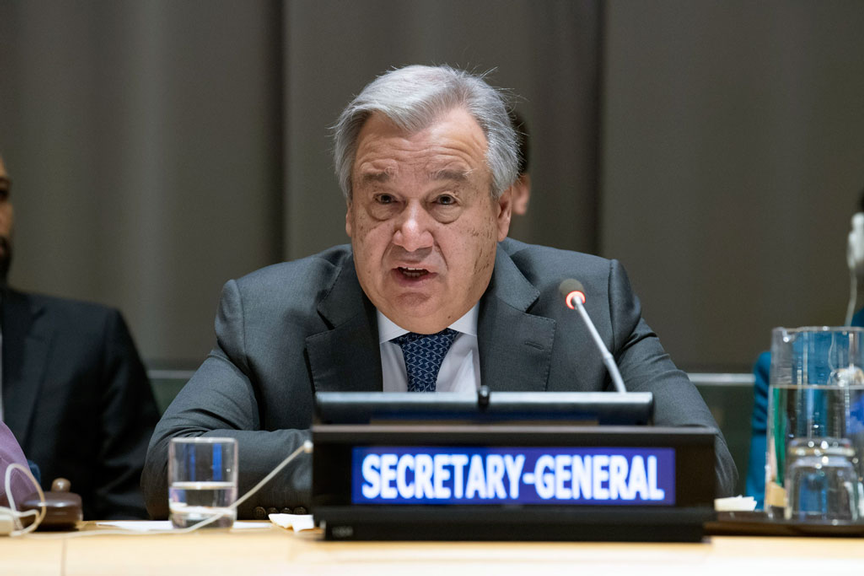
BASSETERRE, St Kitts -- AS artificial intelligence (AI) systems become increasingly capable and widely deployed, United Nations Secretary-General António Guterres is warning that the risks associated with unchecked technological development are growing, calling for stronger safeguards and greater international cooperation.
Speaking amid ongoing discussions about AI's role in a changing geopolitical landscape and safety, Guterres said recent technological outages and cyberattacks have highlighted the dangers of an increasingly interconnected digital world.
He also pointed to warnings from some of the pioneers and developers of artificial intelligence, who have raised concerns about the technology's potential existential risks.
"When those developing the technology themselves tell us that the risks could be profound, the world has a responsibility to take those warnings seriously," he said.
Guterres, speaking during the Bridgetown Special Summint on Ai Safety in barbados on Monday (Nov. 23), outlined several concerns, including technology without accountability, capabilities without safeguards, and power without responsibility, noting that countries have unequal capacity to manage the risks associated with AI.
He warned against allowing artificial intelligence to deepen existing global inequalities, arguing that solutions must be as international as the risks themselves.
Addressing the summit, the UN chief said the discussions could help countries strengthen their national approaches to AI governance without imposing a single model on everyone.
He said this would require a shared understanding of emerging risks, greater interoperability through comparable evaluations and common terminology, as well as the sharing of lessons from serious incidents.
He also stressed the importance of strengthening countries' ability to assess whether AI systems are safe and effective within their own local contexts.
Guterres pointed to the UN-supported Global Network for Exchange and Cooperation on AI Capacity Building, which already has 27 centres of excellence across five regions, and reiterated his proposal for a Global Fund for AI Capacity-Building.
He said efforts to govern AI must be grounded in independent science, including the work of the Independent International Scientific Panel on AI, which is participating in the meetings.
According to Guterres, the panel's first report found that safeguards are lagging behind the rapid advancement of AI capabilities, reinforcing the need for stronger protections as the technology becomes more widely used.
"Wider deployment requires stronger safeguards. Safety must travel with the technology," he said.
He also referenced a thematic brief on AI capacity-building released the previous day, which examines how countries are working to close gaps in their ability to govern digital technologies, particularly in evaluating AI systems to ensure they are safe across different languages and cultural settings.
However, Guterres said more work is needed to adequately manage the risks, prompting his call for a multilateral framework for AI risk management supported by credible and independent oversight.
"The world cannot afford a race to the bottom on AI safety," he warned.
He highlighted several international efforts aimed at advancing AI governance, including the first Global Dialogue on AI Governance held in July, the Call for Control of Frontier AI Models launched by Finland and Norway, and the Paris Call for AI Safety and Security.
Guterres said the upcoming Bridgetown meeting represents another step towards ensuring AI systems are safe and trustworthy, regardless of where they are developed or deployed.
He stressed that both the technology and the systems governing it must serve all countries, not just those with the greatest technological or economic power.